



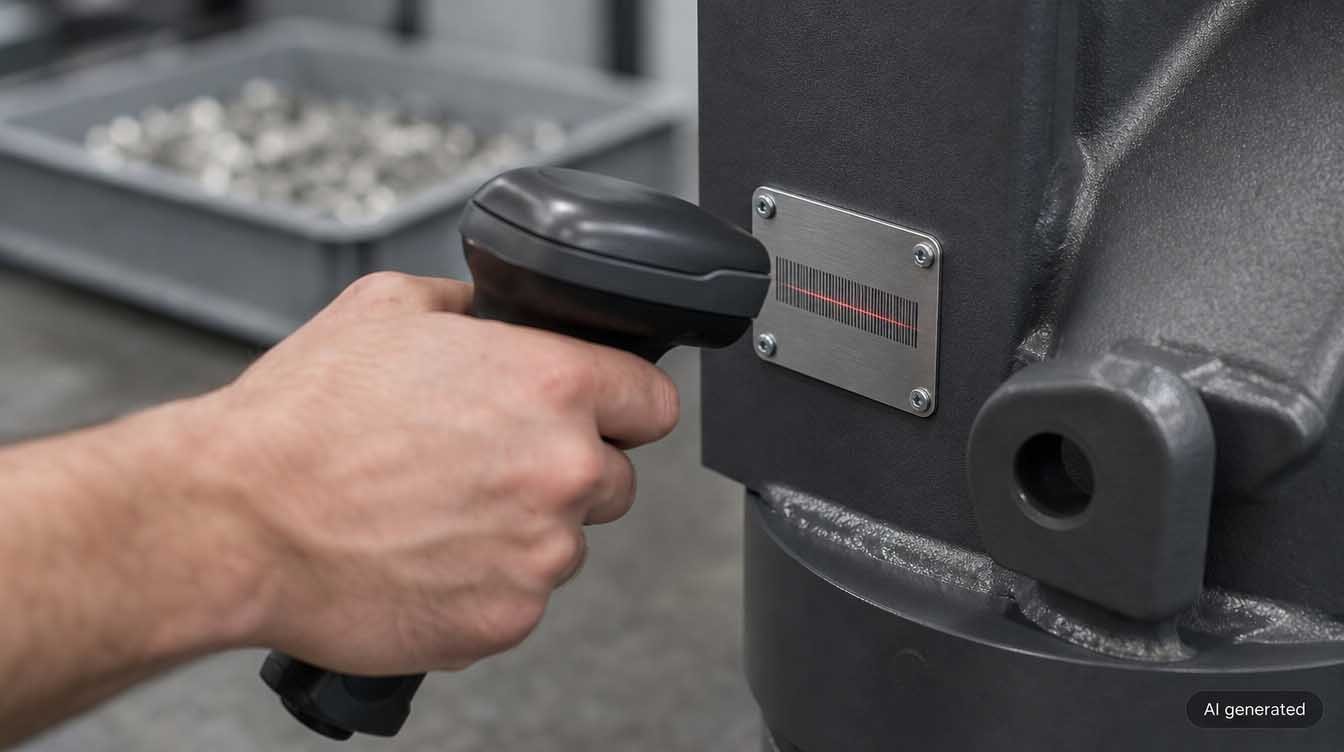
The customer is asking for a single component—serial number, manufactured eleven months ago. Three colleagues start searching: one in the MES, one in the test database, and one in the export files from the screwdriver control system. After two days, there’s a spreadsheet on the table, but the timestamps don’t match up. No one did a poor job. There just was never a common reference point.
This situation is the rule, not the exception. In most manufacturing operations, all the necessary data exists. It just exists in different systems, under different identifiers, with different time bases. As long as no one asks to trace the data back, it goes unnoticed. But it’s precisely the customer, the auditor, and the lawyer who ask to trace the data back.
The usual reflex is to buy yet another tool. A better QM system, a more modern MES, specialized inspection software. The result is usually a more powerful fourth system—and the same disconnect between them. The question isn’t which tool is the best, but how the data from these tools can be integrated.
This article describes what distinguishes a quality platform from a collection of good individual solutions, which four data streams belong together, how assembly-integrated inspection and operator guidance interact within it, and where individual solutions should intentionally remain separate. It’s about architecture, not vendor comparison.
THE MOST IMPORTANT POINTS IN A NUTSHELL
|
IN SHORT
|
Three Systems, One Component, No Common Key
The situation, which is found almost everywhere in mass production, seems harmless. Every single system works. The ERP system tracks orders and quantities. The MES plans and reports back. The testing equipment generates measurement values. The operator guidance system displays instructions. There is no obvious error that could be corrected.
The disconnect lies one level deeper. It arises where two systems name the same component differently, label it differently, or don’t recognize it at all. The following list shows the four points of disconnect that occur most frequently in projects.
| Point of Disconnect | What It Looks Like | When it becomes apparent | What it means in an emergency |
|---|---|---|---|
| No shared primary key | The MES uses order numbers, the testing equipment uses test item numbers, and the technician uses station counters | Upon the first inquiry regarding a single serial number | The history is reconstructed manually, with residual uncertainty |
| Divergent time bases | System clocks drift apart; time zones and daylight saving time are handled differently | When two events appear in the wrong order | The causal chain cannot be verified, even if it is correct |
| Duplicate master data | Variants and part numbers are maintained in multiple systems and drift apart | When launching a new variant | Inspection specifications do not match the actual build status |
| Documentation is scattered across multiple locations | Some of the documentation is in the QM system, some in file repositories, and some in legacy systems | In the week before the audit | Audit preparation becomes a special project with its own budget |
It is worth noting that none of these disconnects is a functional deficiency. All four are integration deficiencies. That is why they cannot be resolved by purchasing a better standalone system. A new MES with the same missing key will create the same gap—only faster.
What a media break in assembly actually costs
Media breaks aren’t assigned to any single cost center. They’re spread across various line items, each of which has a plausible justification. That’s precisely why they often go unaddressed for a long time. There are five cost categories that can be identified and verified within your own organization.
FIVE COST CATEGORIES THAT CAN BE QUANTIFIED
|
A sample calculation makes the first point tangible, using figures from your own company rather than from a study. Over the course of a quarter, record how many inquiries you receive regarding individual components or batches—whether from customers, final assembly, or the complaints department. For each case, record how many people were involved and how long it took to arrive at a reliable answer. The sum of these figures is the only number that carries weight in an investment discussion, because it comes from your own organization and no one can dispute it.
In practice, it’s almost always the variation—not the average—that comes as a surprise. Most inquiries are answered within minutes because the part in question is new and the data is still available in the production systems. The few cases where a transaction dates back several years and the systems that generated it have since been replaced or migrated are the costly ones. It is precisely these cases that matter in the event of a complaint or liability claim, and they are the very ones that fall out of the picture when looking at averages.
The last item is the most expensive and the hardest to detect. It determines whether a defect affects twenty parts or an entire shift. How recall costs develop according to this logic is calculated in the article on recall costs and traceability.
What Sets a Quality Platform Apart from Good Individual Tools
The term “platform” is used loosely in the market. A collection of modules from a single manufacturer does not constitute a platform if the modules communicate internally via export files. Four characteristics are decisive, and they are all verifiable.
| Characteristic | Specific Question to Ask the Provider | What a Weak Answer Reveals |
|---|---|---|
| Common Primary Key | Which field links process data, inspection results, and operator steps, and who assigns it? | If the answer lists multiple keys per module, it is a collection, not a platform |
| Common time base | Where do all components get their time from, and how is drift handled? | If each module uses the local system time, the sequence of events is not reliable |
| A master data model | Where are variants and test specifications maintained, and how often? | If variants are maintained in two places, drift is only a matter of time |
| A single location for documentation | Which system does the audit report come from, and what is missing from it? | If the report is compiled from multiple sources, audit preparation remains a project |
The practical test is simpler than any list of requirements. Name any serial number from the previous year and have the complete history displayed: process values, test results, confirmed work steps, tools used along with their inspection status, deviations, and decisions. How long this takes and how many people are needed to do it describes the maturity level more accurately than any presentation.
The question of a manufacturing operation’s maturity is not how many systems are in use. It is how many people it takes to fully account for a single serial number.
The four data streams that belong together
In this setup, such a database brings together four streams. Each provides a part of the answer that no other can provide. The table shows what each stream contributes and which question remains unanswered if it is missing.
| Data Stream | What It Provides | If it is missing, there is no answer to |
|---|---|---|
| process data from machines and systems | Actual and target values per cycle, trend curves, system status | Was the process even under control at the time of production? |
| Inspection and tooling data | Measurement results, torque and angle, test equipment status, and calibration status | Was the tool serviceable and inspected at the time of use? |
| Confirmed operator step | Which step in which version of the instructions was performed by whom | Was the work actually performed as specified? |
| Long-term archive | The same data set, accessible for the required retention periods | Will we still be able to answer this question eight years from now? |
The second line is most often underestimated. A torque value without the tool’s test status is vulnerable in an audit because it does not prove that the measuring instrument was capable at the time of measurement. For safety-critical bolted joints, this is not a mere formality: VDI/VDE 2862 Part 1 classifies bolting cases according to the severity of potential consequences and imposes specific documentation requirements on Classes A and B. The minimum requirements that result from this are broken down in the explanation of the bolting case classes. The accompanying article discusses how to establish a robust process data management system in manufacturing to meet these requirements.
Equally important is the order in which these four data streams are integrated. It has proven effective to start with the data stream that raises the most unanswered questions, rather than the one that is technically the simplest. In manual assembly, this is usually the confirmed operator step, because it closes the only gap that no other system can fill. In highly automated areas, it is the process data stream from the equipment. Archiving is best left for last, because only then can it capture a complete set of data.
Inspection Integrated into Assembly Rather Than Post-Assembly Inspection
The traditional approach separates manufacturing and testing both spatially and temporally. Assembly takes place on the production line, followed by testing—often at a separate station and performed by a different organizational unit. This separation has historical roots and comes at a high cost.
| Criterion | Inspection after assembly | Inspection Integrated into Assembly |
|---|---|---|
| Time of Detection | After the assembly is complete, sometimes several shifts later | In the same cycle in which the defect occurs |
| Quantity affected in case of deviation | Everything between two inspection points, often an entire batch | The current part; in the worst-case scenario, a few parts |
| Re-work effort | Disassembly required, since subsequent steps have already been completed | Correction performed while the part is open, without disassembly |
| Data on the cause | Result without process context; cause must be reconstructed | Result linked to process values for the same step |
| Impact on lead time | Additional station, additional transport, waiting time | Inspection step is part of the cycle |
It is important to draw a clear distinction. In-process inspection does not replace every final inspection. Functional tests on the finished product, leak tests of the entire assembly, and customer-specific acceptance tests remain downstream. What is moved up in the process are the characteristics that are generated within the takt time and can also be measured there: tightening torque values, presence of components, dimensions in the open state, and inspection steps with clear criteria.
Operator guidance as a data source, not as a display
In discussions of architecture, digital worker guidance is usually classified as a user interface. This underestimates its role. In manual assembly, it is the only point where data about the work step itself is actually generated. Without it, the system knows the machine values and inspection results, but not the activities in between.
Specifically, the confirmed step provides four fields that no other system has: which step was performed, in which version of the instruction, by which user ID, and with which reported deviation. Only then does a collection of measured values become a process history.
THREE CONDITIONS FOR WORKER GUIDANCE TO PROVIDE DATA
|

MES-based control: which decisions are made where
The most common question in discussions about system architecture is whether a quality platform replaces the MES. The answer is no, and the reason is a matter of responsibility. The MES and the quality platform make different decisions on different time scales.
| Level | Decides on | Time Scale | Typical Metric |
|---|---|---|---|
| ERP | Order, Quantity, Due Date, Material | Days to weeks | On-time delivery |
| MES | Sequence, Capacity, Execution Confirmation | Hours to days | Utilization, lead time |
| Quality platform | Whether this step is approved for this part | Seconds to minutes | First-pass yield, traceability |
| Control and tooling | Parameter set, lock, release on the device | Milliseconds to seconds | Process Capability |
In practical terms, MES-integrated control involves exactly two data streams and no more. The job context is fed into the system so that the correct variant is active at the station without manual selection. Process, inspection, and step data are fed out as feedback. OPC UA, REST, and MQTT are commonly used for this purpose. The article on MES and ERP integration in quality management discusses which integration patterns have proven effective in practice.
A word of caution is in order, as this is regularly overlooked in projects. Integration does not resolve data quality issues. If variant and part numbers are assigned differently across the involved systems, the interface will simply propagate the error more reliably. Master data cleansing must take place before integration, not after.
What happens during assembly and what counts in the audit
The value of a quality platform comes down to a single scenario: someone asks for information retroactively—whether it’s a customer, a certification body, a regulatory agency, or a lawyer. In that case, what matters isn’t how much data has been collected, but which pieces are related and how quickly they can be provided.
| Recorded Information | Reference to a standard or reason | What it is used for in an emergency |
|---|---|---|
| Serial number as a unique identifier | IATF 16949 Section 8.5.2 | Precisely defines the affected scope rather than blocking it as a precaution |
| Instruction version for each step | IATF 16949 Section 7.5 | Demonstrates that the valid specification was in effect at the time of production |
| Verification of critical steps | IATF 16949 Section 8.5.1 | Demonstrates controlled production conditions rather than a mere declaration of intent |
| Torque and angle for each screw connection | VDI/VDE 2862 Part 1, Classes A and B | Verification of safety-critical joints |
| Test equipment and tool status | ISO 9001:2015 Section 7.1.5 | Documents the capability of the measuring equipment at the time of measurement |
| Nonconformity with decision and responsible party | ISO 9001:2015 Section 10.2 | Documents corrective actions in a traceable manner |
| Audit-proof storage in accordance with retention periods | Product liability, retention requirements | Ensures the ability to provide information even years later |
The key difference from retrospective documentation is that this information is generated as a byproduct of the execution process and not as a separate activity. The article on audit readiness in manufacturing describes how a robust chain of evidence can be established within a manageable timeframe. Audit-compliant archiving in production is also essential for the long-term availability of this data, because retention periods regularly exceed the lifespan of the systems that generate them.
Why “Platform” Isn’t Called “Monolith”
The valid objection is that you end up creating dependencies and losing technically superior specialized tools. This objection is valid if the whole system is viewed as a monolith. It is unfounded if the platform serves as the data layer and does not claim to provide every function itself.
| Situation | Recommendation | Condition |
|---|---|---|
| Specialized software is clearly superior in technical terms, for example in measurement technology | Keep | It delivers results with a common key and a common time base |
| Multiple systems cover the same function at different locations | Consolidate | Only after master data has been standardized—not before |
| The legacy system retains the history exclusively and is operated solely for that purpose | Replace and archive | The data set is transferred in an audit-compliant manner |
| In-house development with in-depth process knowledge and a designated person in charge | Handle with care | Knowledge transfer and interface assessment before any decision to replace the system |
The third case is the most interesting from an economic perspective because it ties up ongoing costs without providing ongoing benefits. A system that is operated solely so that information can be looked up when needed is an archiving problem, not an application problem. The reasoning behind this can be found in the article on decommissioning legacy systems in manufacturing.
The CSP Manufacturing OS as a Quality Platform
The CSP Manufacturing OS is designed precisely as this data layer. Four modules operate on a shared database, with the serial number serving as the unique primary key. The modules can be implemented individually but share the same key, time base, and master data model from the outset.
| Module | Function | Contribution to the Chain of Custody |
|---|---|---|
| IPM | Process data management, machine and plant integration | Provides actual and target values at regular intervals via OPC UA, REST, MQTT, and other protocols |
| QST | Inspection of joining processes, tool and process inspection | Documents the capability and inspection status of tools and measuring equipment at the time of use |
| PGX | Digital operator guidance through assembly, inspection, rework, and revision | Provides the step, instruction version, user ID, and reported deviation |
| CHRONOS | Audit-proof long-term archiving | Keeps the same data set accessible throughout retention periods without requiring legacy system operation |
The difference from a loosely coupled modular system lies in the sequence of decisions. Implementation begins at a single point—typically where the pain is greatest—and subsequent modules build upon the same data foundation. A second integration is unnecessary because the key remains the same from the start. This is precisely what transforms a series of individual projects into a cohesive development.

Frequently Asked Questions
What is a quality platform in manufacturing?
A quality platform is the common data layer on which process data acquisition, inspection, operator guidance, and archiving operate using a single primary key—typically the serial number. It differs from a collection of good individual tools not by offering more functions, but by four characteristics: a common key, a common time base, a master data model, and a single location for documentation.
Does a quality platform replace the MES?
No. The MES and the quality platform make different decisions on different time scales. The MES plans sequence and capacity over hours and days. The quality platform decides within seconds whether a single step on a single part is approved and then documents it. The connection consists of two data flows: order context in, process and inspection data out.
How can I identify data disconnects in my own quality management system?
The quickest way is with a single exercise. Name any serial number from the previous year and have the complete history compiled: process values, inspection results, confirmed work steps, tool status, and deviations. The number of people involved and the time required describe the level of maturity more accurately than any system map. More than one person involved indicates a lack of a common key.
What are the benefits of assembly-integrated inspection compared to a final inspection?
It shifts detection to the very cycle in which the defect occurs. This reduces the quantity that must be held up in the event of a deviation, rework is possible without disassembly, and the inspection result is linked to the process context of that same step. It does not replace the final inspection: functional tests on the finished product and customer-specific acceptance tests remain downstream.
What role does digital operator guidance play in a quality platform?
In manual assembly, it is the sole source of data regarding the work step itself. Machines provide process values, and testing equipment provides measurement values, but only operator guidance specifies which step was performed by whom according to which version of the instructions, and which deviation was reported. Without these four fields, there remains a gap between the measured values—and in the event of a complaint, that is precisely the information that is needed.
Does “platform” mean we have to replace all specialized solutions?
No. Where a specialized tool is technically superior—for example, in measurement technology—it remains useful. The condition is that it delivers its results using the common key and the common time base. Consolidation is particularly worthwhile where multiple systems cover the same function at different locations, and for legacy systems that are still in operation solely for data access.
What does it cost to get started with a quality platform?
The cost depends less on the software than on the condition of the master data and the number of systems to be integrated. More telling than the purchase price is the cost analysis: reconstruction effort per inquiry, excessively large blocked quantities, duplicate data entry, and audit preparation as a recurring project. Starting with a single line or process limits the initial risk and makes the impact measurable early on.
Will integration solve our data quality problems?
No, and this expectation is the most common cause of failed projects. If variant and part numbers are assigned differently in the systems involved, the interface will simply propagate the error more reliably and quickly. Standardizing master data and clarifying which system is the primary source for each field must be done before integration.