


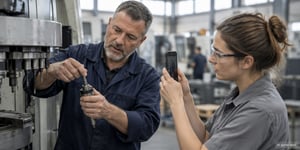
Think of the most experienced setter in your plant. He can hear when a tool needs adjusting, and he knows the moves that fix a fault in minutes instead of hours. How much of that is written in a work instruction? And who does it once he retires?
Key takeaways
Knowledge retention in manufacturing means capturing the experience of individual employees so that others can access and apply it at the workstation.
According to the German Federal Statistical Office, 13.3 million people in the German labor force will reach the statutory retirement age within the next 15 years, around 30 percent of the entire labor force.
ISO 9001 requires in clause 7.1.6 that the knowledge needed for processes is determined, maintained and made available.
Hand movements and special cases are best captured on video at the workstation, split into sections, translated and completed with a knowledge test.
In brief
Start early
Expert knowledge can only be captured while the person is still in the plant.
Choose deliberately
Start with tasks that only one person masters and that are critical to quality.
Check the result
Knowledge is only retained once others can apply it and that has been verified.
In this article
01 What does knowledge retention in manufacturing mean?
02 How much expert knowledge will leave the plants in the coming years?
03 Which knowledge is most at risk in manufacturing?
04 Which knowledge retention methods exist, and what do they achieve?
05 Why does video capture hand movements better than text?
06 How does knowledge retention work in five steps?
07 How does SKILL in the Manufacturing OS support knowledge retention?
01 · Basics
What does knowledge retention in manufacturing mean?
Knowledge retention in manufacturing is the systematic capture and transfer of knowledge that a production process needs and that so far exists only in the heads of individual employees. The goal: the process runs no matter who is at the station.
A distinction helps. Explicit knowledge can be written down, such as torque values, inspection intervals or the sequence of assembly steps. It is usually already in work instructions and inspection plans. Tacit knowledge lives in the doing: the grip that seats a part without tilting, the sound of a worn drill, the order in which an experienced setter narrows down a fault. Most documents lack this knowledge because it seems obvious to the person who has it.
Knowledge transfer and knowledge retention are related but not the same. Knowledge transfer moves knowledge from one person to the next. Knowledge retention makes sure it is still available years later, even if the successor has left the plant as well.
Quality management requires knowledge retention too. ISO 9001:2015 covers the topic in clause 7.1.6 "Organizational knowledge": the organization must determine the knowledge needed for its processes and for conforming products, maintain it and make it available to the extent necessary. The annex of the standard names protection against loss of knowledge as the motivation.
02 · Situation
How much expert knowledge will leave the plants in the coming years?
The baby boomer generation is retiring, and it is happening now. According to the German Federal Statistical Office (Destatis), 13.3 million people in the labor force will reach the statutory retirement age within the next 15 years. That is around 30 percent of the entire labor force. The younger age groups are smaller and cannot close the gap in numbers.
A June 2026 report by the German Economic Institute (IW) shows how fast this is going. Of the more than 19 million baby boomers, 14.1 million are currently still below the statutory retirement age. In 2030 it will be only 7.6 million, a drop of 46.3 percent. By 2036 the last cohort will have reached retirement age, and the IW expects a shortfall of 4.3 million workers by then.
13.3 m
people in the labor force reach retirement age within 15 years
Source: Destatis
30 %
of the entire labor force leaves the job market
Source: Destatis
46.3 %
fewer baby boomers of working age between now and 2030
Source: IW, short report 39/2026
4.3 m
workers missing by 2036
Source: IW, short report 39/2026
For manufacturing this means the bottleneck is not far in the future. According to the IW, the largest baby boomer cohorts reach retirement age in the second half of the 2020s. Plants without a plan for knowledge retention today will capture knowledge later under time pressure, or not at all.
03 · Risk
Which knowledge is most at risk in manufacturing?
Not all knowledge is equally critical. Knowledge is most at risk when it is rarely needed, held by only a few people and has a direct effect on quality or availability. Four areas fall into this category in many plants.
Setup and changeover
Details of tool changes and adjustments that only stick after many repetitions.
Troubleshooting
The order in which an expert narrows down a fault is rarely written in a manual.
Special cases and variants
Rare variants, rework and exceptions that occur only every few months.
Sensory cues
Sounds, smells, surfaces: signals that experts notice at once and newcomers miss.
Practical tip: The station with only one person
Go through your qualification overview station by station and mark every task that only a single person can perform independently. These stations belong at the top of your knowledge retention list, especially if that person will retire in the next few years.
04 · Methods
Which knowledge retention methods exist, and what do they achieve?
Five approaches are common in practice. They differ in how much tacit knowledge they capture and whether the result is still usable after the expert has left.
| Method | What it captures | What gets lost | Usable after the expert leaves |
|---|---|---|---|
| Handover meeting | Responsibilities, open topics, contacts | Hand movements and everything the expert takes for granted | Only as minutes |
| Tandem with the successor | The actual work including all corrections | Everything the successor does not remember | Only through that one person |
| Written documentation | Values, sequences, specifications | Movements, sounds, feel for the material | Yes, if it is maintained |
| Digital work instruction with images | Step sequence, check points, variants at the workstation | Reasons and special cases unless someone adds them | Yes, tied to the process |
| Video course with knowledge test | Hand movements, the expert's explanations, special cases in his words | Little, as long as the course is kept up to date | Yes, for any number of people |
The methods do not exclude each other. The tandem is the most effective way to pass on knowledge, but it reaches exactly one person and ends on the expert's last working day. It pays off most when you use the tandem phase to record knowledge instead of only handing it on. How digital work instructions are built and maintained is described in our article on digital work instructions.
Whitepaper
Management of quality relevant production data
How to connect quality data along production, detect deviations early and meet audit requirements reliably.
05 · Video
Why does video capture hand movements better than text?
A text describes what to do. A video shows how it is done. With tacit knowledge, that is exactly what makes the difference.
Effort matters too. To write down his knowledge, an expert first has to put it into words, and that works poorly for hand movements. A smartphone video in which he performs the task and explains what he pays attention to takes only as long as the task itself. He mentions special cases along the way because he has them in mind while working.
A video alone is not knowledge retention yet. Nobody on the line watches an uncut forty minute recording. To turn it into a learning tool, it needs short sections, text and audio in the team's languages and a check whether the content was understood.
Key point
Knowledge is only retained once another person can apply it and this can be shown. A video on a shared drive is a start, but not yet proof.
Practical tip: Involve the works council early
Videos at the workstation show employees at work. Under section 87 (1) no. 6 of the German Works Constitution Act (BetrVG), the works council has a say when technical equipment is introduced that is intended to monitor employee behavior or performance. Before the first recording, clarify with the works council and your legal department what the recordings will and will not be used for.
06 · Implementation
How does knowledge retention work in five steps?
Knowledge retention does not have to be a large project. You can start with a single station and then roll the approach out to other areas.
Find experts and critical tasks
Which tasks does only one person master, and who will retire in the next few years? A qualification overview per station provides the answer.
Select by risk
Start with what is critical to quality, rarely occurs and will soon be mastered by no one.
Record at the workstation
The expert performs the task and explains what he pays attention to. A smartphone video is enough. Record special cases right away.
Structure, review, translate
Split the video into sections, create text and translate it into the team's languages. A subject matter expert reviews and approves.
Check understanding and keep it current
A knowledge test shows whether the content got across. When the process changes, record again and distribute it as a new version.
Plan ahead. Expert knowledge can only be captured while the person is still in the plant. Starting in the last few weeks before retirement usually yields nothing more than handover minutes.
07 · Manufacturing OS
How does SKILL in the Manufacturing OS support knowledge retention?
CSP Intelligence, based in Großköllnbach in Lower Bavaria, has been developing software for manufacturing since 1991. The CSP Manufacturing OS connects process data, worker guidance, inspection and archiving in one platform. SKILL is the module for preserving knowledge and qualifying teams.
SKILL turns a smartphone video or an existing PDF work instruction into a structured course. Sections, transcript and translations are created in one run. The AI suggests structure and text, but the course only becomes visible after approval by the subject matter expert.
Record
Smartphone video or PDF work instruction as source material.
Structure
Sections, transcript and translation into every language of the team.
Test
Knowledge test at the end of the course, created automatically in every language.
Prove
Result and course version are stored in the qualification record.
When a process changes, a new video is enough. SKILL creates a new course version, and all sites work with the same status. At the station itself, PG, CSP's digital worker guidance, complements qualification: PG guides employees step by step through assembly and inspection and documents every step. How to choose the right system is covered in our article on selecting worker guidance software. All functions are on the page about employee qualification with SKILL.
08 · FAQ
Frequently asked questions about knowledge retention
What is knowledge retention in manufacturing?+
Knowledge retention in manufacturing is the systematic capture and transfer of knowledge that a production process needs and that so far exists only with individual employees. Besides values and sequences, this mainly includes hand movements, special cases and how faults are handled. The goal is a process that works independently of individual people.
What is the difference between knowledge retention and knowledge transfer?+
Knowledge transfer moves knowledge from one person to the next, for example in a tandem. Knowledge retention records the knowledge so that it remains available later, for any number of people and regardless of whether the original successor is still in the plant.
When should knowledge retention start before a retirement?+
As soon as the exit date is foreseeable. The more lead time you have, the more special cases and faults actually occur during that time and can be recorded. Starting in the last few weeks usually yields only handover minutes.
Does ISO 9001 require knowledge retention?+
Yes. ISO 9001:2015 requires in clause 7.1.6 that the knowledge needed for processes and for conforming products is determined, maintained and made available to the extent necessary. The standard does not prescribe how the organization does this.
Which knowledge should be captured first?+
Start with knowledge for tasks that only one person can perform independently, that are critical to quality and that occur rarely. Typical examples are setups, troubleshooting and rare variants. It is especially urgent if the expert will retire in the next few years.
Why are videos suitable for knowledge retention?+
A video shows hand movements that are hard to describe, and the expert can explain what he pays attention to while working. To work as a learning tool, it should be split into short sections, translated into the team's languages and completed with a knowledge test.
Does the works council have to approve video recordings at the workstation?+
In Germany, section 87 (1) no. 6 BetrVG gives the works council a say on technical equipment intended to monitor employee behavior or performance. Whether this applies to training videos depends on how they are used. Clarify the purpose and use of the recordings early with the works council and your legal department.
Next step
See SKILL on your own process
Send us a video and a work instruction. In 30 minutes we will show you the finished course, in your languages, with your sections.