


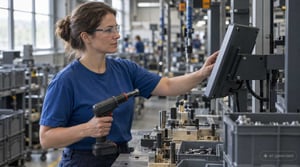
The torque wrench indicates the part is acceptable. 42.3 Nm, specification range 40 to 45 Nm—everything is within spec. The worker confirms the step, and the component moves on to the next stage. Six weeks later, it comes back as a complaint: the connection has come loose. The curve never went outside the tolerance range. It just had a small dip in the rise, like the one caused by a nicked thread. No limit value in the world could have detected this, because limit values check final values, not shapes. A model that knows ten thousand clean torque curves for the same screw connection would have spotted it. That is exactly what intelligent operator guidance is all about.
THE MOST IMPORTANT POINTS AT A GLANCE
|
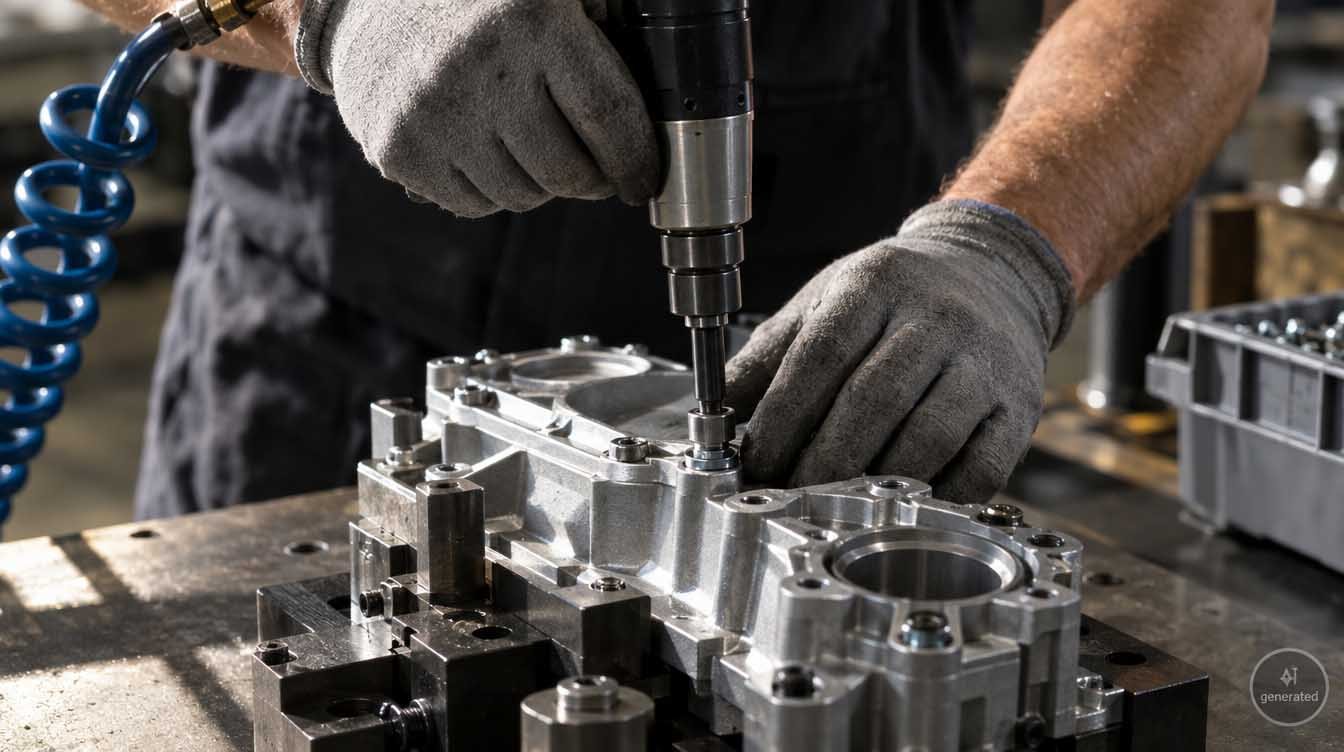
Before intelligent worker guidance can even be considered, it’s worth taking a look at the current situation. The assembly station is the point in production where the most decisions are made per minute and the least data is generated. A machine provides cycle times, temperatures, and pressures at one-second intervals. A manual assembly station, when operating on paper, involves checking a box on a list—often done at the end of the shift.
Digital worker guidance has closed this gap. It provides step-by-step instructions, documents each step with the worker’s ID and a timestamp, and makes process changes effective immediately at all stations. This creates, for the first time, a data stream that can be analyzed. And it is precisely this data stream that is the prerequisite for the next level: a system that not only guides and documents, but also evaluates what has been documented.
This article explains what intelligent worker guidance entails from a technical perspective, which AI functions are currently in productive use on the assembly line and which are still in the pilot phase, what data infrastructure they require, where the limitations lie, and what specific requirements the AI Regulation under the Digital Omnibus Act of July 2026 mandates. If you’re looking for the definition, benefits, and implementation roadmap for the basic level, you’ll find them in the article on digital worker guidance.
IN A NUTSHELL
|
What intelligent worker guidance is and where the line is drawn between it and digital worker guidance
Intelligent operator guidance is an operator guidance system that analyzes the process and confirmation data collected at the assembly station using machine learning models and generates instructions, warnings, or adjustments to the sequence of steps based on that analysis. The operator still sees the steps. What changes is the entity that determines whether a step was correct.
The difference can be precisely defined. A rule-based system checks against a specification defined by a human: torque between 40 and 45 Nm, angle between 30 and 45 degrees, scan present. An intelligent system checks against a pattern learned from historical data: Does this curve match the patterns that have previously resulted in good parts? Both checks are necessary. The second one captures exactly what the first one structurally misses.
| Key Metric | Meaning |
|---|---|
| 4 out of 7 | AI functions on the assembly line will be ready for series production by 2026; three are currently in the pilot phase |
| 100% | Mandatory monitoring for every single screw connection in Category A fastening applications |
| 12 months | Minimum data set depth to ensure that tool changes and batch changes are covered |
| Dec. 2, 2027 | Effective date of the high-risk obligations under Annex III of the AI Regulation |
In practice, there are four distinct levels between paper-based and intelligent management. This classification is not a marketing scale but a data scale: each level produces the data quality required for the next.
| Level | How Management Is Conducted | What Is Documented | What Can Be Evaluated |
|---|---|---|---|
| Level 1: Paper | Notice board, tracking form, verbal communication | Checkmarks on paper, often added later | Nothing. No machine-readable data exists. |
| Level 2: Digital, static | PDF or image gallery on a tablet | Document access, no step-by-step reference | Only whether the document was opened. |
| Level 3: digital, process-dependent | Step-by-step, variant-driven, locked in case of deviation | Each step includes operator ID, timestamp, measured value, and component ID | Violations of defined limits, completeness, cycle times. |
| Level 4: Intelligent | Step-by-step plus model-based guidance and prioritization | Additionally, complete time series for each step and labeled error cases | Patterns: waveform, drift, correlations, anomalies within tolerance. |
THE TYPICAL JUMP ERROR
|
Conceptually, several terms are used to describe the same field. Assembly assistance system, digital assembly assistant, and intelligent worker assistance system refer in practice to systems of the same class, with different emphases: The term “assistance system” emphasizes support for the worker, while the term “worker guidance” emphasizes a mandatory sequence of steps. The specific term is irrelevant for evaluating a proposal. What matters is whether the system can enforce and document steps and on what data it bases its evaluation. In the following, we consistently use the term “intelligent worker guidance” because it conveys the mandatory nature of the sequence of steps.
Which AI functions will be ready for practical use on the assembly line in 2026
The discussion about AI-assisted worker guidance suffers from the fact that pilot projects and mass production are not distinguished in the terminology used. On the assembly line, this distinction can be clearly drawn because the data requirements vary greatly depending on the function. The following classification describes seven functions and the level of maturity they have reached in mass production.
| Function | What It Does | Data Requirements | Maturity Level |
|---|---|---|---|
| Anomaly Detection in Process Curves | Detects anomalies in screw-fastening, press-fit, and joining curves that fall within tolerance | Complete time series for each screw connection, with at least several thousand successful cases per screw connection | Ready for series production |
| Image-Based Completeness Check | Checks the presence, position, and orientation of components at the end of an assembly step | Fixed camera position, constant lighting, sufficient error images per error class | Ready for series production with stable optics |
| Multilingual instruction output | Translates instruction texts and keeps versions synchronized across languages | Structured instruction texts with unique step IDs | Ready for mass production |
| Risk-based prioritization of inspection steps | Increases inspection frequency where the model and history indicate an elevated risk of deviation | Links inspection results to process parameters over a period of at least twelve months | Ready for series production in conjunction with a test plan |
| Adaptive step-by-step guidance based on experience level | Adapts the level of detail and frequency of prompts to the worker’s skill level and experience | Qualification matrix plus error history per worker, in compliance with labor laws | Pilot |
| Root-cause suggestion in case of a deviation | Suggests probable causes based on comparable incidents when a deviation occurs | Labeled cause assignment from deviation management, clearly tagged | Pilot |
| Voice-based deviation recording | Records deviation descriptions via voice and assigns them to a fault class | Error catalog with stable classes; hall acoustics are manageable | Pilot |
The line between production-ready and pilot is not drawn based on model complexity, but rather on whether there are clearly labeled negative examples. Anomaly detection in curves works because it only needs to know what “normal” looks like. A root-cause suggestion only works if causes have been systematically recorded in the past, and in most deviation management systems, this information is stored as free text.
Those who want to contextualize these functions beyond the assembly line will find a broader framework in the article on AI in manufacturing quality assurance. For the predictive aspect—that is, forecasting quality issues based on process parameters— “Predictive Quality” is the right place to start.
How AI Detects Assembly Defects That Fall Within Tolerance Limits
This is the core of the issue, and it is rarely explained precisely. Conventional screw fastening monitoring checks final values: torque at the cut-off point, angle of rotation from the joining torque, and, if applicable, the gradient within a defined window. This inspection is necessary and mandated by standards. VDI/VDE 2862 Part 1 requires monitoring of every single screw connection for Category A applications—that is, those posing a risk to life and limb. However, it does not state that monitoring a single end value will detect every error.
This is because the final value is a scalar, and the process is a curve. Two screw connections can reach the same final torque but follow completely different paths to get there. The path contains information about the condition of the thread, the component, the mating part, and the tool.
The following overview categorizes typical assembly defects according to their characteristics in the curve and indicates whether a final value check alone can detect them. The defect examples are taken from CSP customer projects in the automotive and mechanical engineering industries.
| Defect Pattern | Characteristic in the curve profile | Detectable via end-value inspection | Consequences in the Field |
|---|---|---|---|
| Nicked or damaged thread | Drop in torque or dip during the rise phase, followed by a normal curve | No | Preload below specification; connection loosens under vibration |
| Missing washer or missing spacer | Significantly shortened tightening stroke with correct final torque | No, if only the torque is monitored | Settlement loss, loosening after operational load cycles |
| Chips or debris in the thread | Irregular threads along the length, increased friction torque | No | Incorrect preload despite correct tightening torque |
| Screw tightened twice | Two distinct rising phases in a curve | Partially, only with angle monitoring | Overstrain, cracking in the component |
| Tool wear | Slow drift in the curve shape over weeks; individual curve appears normal | No | Increasing variation, gradual rise in the rework rate |
| Incorrect screw length from the container | Deviating joining point; rise begins too early or too late | No | Insufficient screw-in depth, thread stripping |
An anomaly model works differently here than a rule. It learns what is normal from a large number of unremarkable curves from the same screw-in operation and reports deviations from this normal. The key point: It does not need examples of the error patterns listed above. It requires enough examples of normal behavior. That is why this feature can be put into production the fastest on the assembly line. The technical implementation and evaluation logic are described in the article on curve outlier detection with Curve Anomaly AI.
WHAT MUST HAPPEN AT THE ASSEMBLY STATION WHEN AN ALERT IS TRIGGERED
|
What AI Handles in Variant Control and Step Recommendations
Variant mix-ups are the most common type of error in worker guidance during assembly processes involving a high number of variants. A clear distinction is necessary here, because a great deal of what is marketed as AI in this field actually isn’t.
Selecting the correct variant is not an AI task. It is an integration task: The MES transmits the production order, the operator guidance system derives the correct instruction variant from it, and the operator does not have to make any selections. If a vendor refers to this as an “intelligent” function, that is a misnomer. The technical details of this integration are explained in the article on operator assistance systems with MES connectivity.
What AI actually contributes in this field lies one level above: plausibility. The rule-based system knows which variant is to be built according to the order. The model recognizes that the observed sequence does not match this variant, even if no single step violates a rule. Typical indicators include: a cycle time that is too short for this variant, a sequence of steps that deviates from the usual, or a torque curve that matches a different joining partner.
Because clues vary in reliability, the response at the assembly station needs to be graded. Four levels have proven effective, ranging from strict to lenient:
| Level | Trigger | Response on-site | Who Decides |
|---|---|---|---|
| Level 1: Hard Lockout | Rule violation against a defined specification, such as torque outside the window | Step cannot be verified; component is marked for rework | System, deterministic |
| Level 2: Statistical plausibility | Value within tolerance but outside the historical process variation | Confirmation only after a repeat measurement or visual inspection | Operator, with mandatory secondary action |
| Level 3: Model alert | Anomaly in the curve or implausible sequence for this variant | Alert with justification, component marked, cycle continues | Operator, documented decision |
| Level 4: Shift evaluation | Cluster of minor alerts across multiple components or drift over several days | No on-site intervention; report to shift management and quality management | Quality Management |
This escalation ladder also serves as the basis for the legal classification of intelligent worker guidance discussed below. Levels 1 and 2 involve process monitoring. Level 3 provides decision support for a human. Only if Level 4 were used to evaluate the performance of individual workers would the legal situation change fundamentally.

How AI Shorts the Onboarding Process on the Assembly Line
Digital worker guidance shortens the onboarding process because the system provides guidance instead of relying on the advice of an experienced colleague. In CSP customer projects, the typical reduction in onboarding time at an assembly station ranges from a factor of two to four, measured from the initial training to working independently at a normal error rate. The article “Shortening Onboarding Time in Manufacturing” discusses this effect in detail.
The additional benefits of intelligent worker guidance can be summarized in three points, none of which are particularly spectacular.
First, language. Instruction texts can be generated in target languages using a model-based approach and kept in sync when changes are made. That may sound trivial, but it solves a real operational problem: Until now, the multilingual nature of an instruction was tied to manual translation cycles, which is why, in practice, only the German version remained up to date after the third process change. An outdated foreign-language version is more dangerous than none at all.
Second, level of detail. Adaptive guidance shows a trained worker the short version and a new employee the detailed version with intermediate screens. The benefits are demonstrable, but implementation is tricky: As soon as the assignment is based on error history rather than a qualification matrix, a performance evaluation is created. More on that below.
Third, common error areas. A model identifies which steps new employees systematically take longer to complete or need to correct more frequently. This is not a finding about the worker but a finding about the instructions: these steps are poorly described. In practice, this is the underestimated lever because it permanently improves the quality of instructions rather than just a single onboarding case.
| Dimension | Paper | Digital, process-dependent | Smart |
|---|---|---|---|
| Process Management | Explanation by experienced colleagues; knowledge remains tied to specific individuals | System guides users step by step; same guidance for everyone | Level of detail based on skill level; abbreviated version for experienced users |
| Language barrier | Text comprehension required | Images and videos bridge the gap; text versions are manually maintained | Model-based, synchronized text versions in all target languages |
| Error reporting | Reported by a colleague when an issue is noticed, often with a delay | Immediately upon rule violation | Additionally, when anomalies are within the tolerance range |
| Improvement of the instructions | Informal; usually gets lost | Feedback can be recorded digitally; evaluation is done manually | Weaknesses in the instructions become apparent from processing data |
| Proof of training | Signed list | Step-by-step proof with timestamps | Additionally, proof of the error level achieved at each step |
PRACTICAL ERROR: ADAPTIVE GUIDANCE WITHOUT PROOF OF QUALIFICATION
|
What Data Foundation Is Required for Intelligent Worker Guidance
The model question is the simpler one in this field. The data question determines success or failure. Six prerequisites must be met, and they are non-negotiable because each one pertains to a characteristic that cannot be reconstructed retroactively.
The Six Data Prerequisites
- Component reference. Every recorded process value requires a unique assignment to a specific component, typically via the serial number as a continuous primary key. Without this reference, a model entry cannot be assigned to any part, and a field complaint cannot be linked to the process history. IATF 16949 requires this association in Section 8.5.2 anyway.
- Time series instead of end values. The curve must be stored, not just the shutdown torque. As a guideline for screwdriving processes: a sampling rate that captures the rise with at least several dozen data points. If you only archive end values, you cannot detect anomalies in the curves, regardless of the model used.
- Operator and tool IDs for each step. Without a tool ID, wear-induced drift cannot be distinguished from component variation. The operator ID is required for traceability according to IATF 16949; however, its use in models must be strictly limited to its intended purpose.
- Labeled negative cases. For pure anomaly detection, positive cases suffice. For any function intended to identify a root cause, incidents with reliably assigned causes are required. Free text in deviation management is insufficient for this; a failure catalog with stable classes is required.
- Temporal Depth. The dataset must include at least one complete tool change cycle and one material batch change. Otherwise, the model will learn the characteristics of a tool or batch as the normal state and report widespread anomalies after the change.
- Consistent process definition. The same step must be recorded on all lines and across all shifts under the same step ID and with the same semantics. Inconsistent process definitions are the most common reason why a model that worked in a pilot on one line no longer functions on a second line.
Establishing this foundation is not an AI project, but a process data project. It is the same work required for robust analyses even without AI, which is why it pays off even if the model is never implemented later. The methodological steps are described in the article on process data analysis in quality assurance.
The phrase we have to say most often in projects is: “Your model will only be as good as your step ID.” Anyone who names the same assembly step differently on Line 1 than on Line 2 does not have an AI problem. They have a master data problem that merely manifests itself as an AI problem.
Amadeus Lederle, Chief Technology Evangelist, CSP Intelligence GmbH
What the AI Regulation Prescribes for AI on the Assembly Line
This section is the most relevant in practice as of September 2026, because the deadlines have changed at short notice. The AI Regulation, Regulation (EU) 2024/1689, has been in effect since August 1, 2024. The amending Regulation (EU) 2026/1744, known as the Digital Omnibus on AI, was published in the Official Journal on July 24, 2026, and entered into force on July 27, 2026—six days before the original deadline for high-risk obligations. It postpones these obligations by sixteen months.
For the assembly site, three classifications must be distinguished, and the distinction depends on the purpose of the system, not on the technology.
| Use Case at the Assembly Line | Classification | Essential obligations | Effective as of |
|---|---|---|---|
| Anomaly detection in process curves, image-based completeness checks, prioritization of inspection steps | Not considered high risk under Annex III, provided it relates exclusively to processes and components | AI competence of the persons involved pursuant to Article 4; transparency pursuant to Article 50 where applicable | Article 4 effective February 2, 2025; Article 50 effective August 2, 2026 |
| Evaluation or monitoring of the performance and behavior of individual workers, task assignment based on model-based decision-making | High risk under Annex III, No. 4 | Risk management system, data governance, technical documentation, logging, human oversight pursuant to Article 14, operator obligations pursuant to Article 26 | December 2, 2027 |
| AI as a safety component of a machine or a medical device | High risk according to Annex I in conjunction with product legislation | Conformity assessment under the relevant product regulation | August 2, 2028 |
| Detection of the worker’s emotions, fatigue, or stress levels | Prohibited practice under Article 5 | Use not permitted; very limited exceptions only for medical or safety reasons | Prohibition in effect since February 2, 2025 |
THE CRUCIAL QUESTION IS THE PURPOSE-BASED CLASSIFICATION
|
Important for planning: The new deadlines are fixed and no longer tied to the availability of harmonized standards. The Digital Omnibus removed this trigger mechanism from the draft and replaced it with fixed dates. At the same time, the postponement is no reason to wait and see: The requirement for AI competence under Article 4 remains unchanged, and the evidence that a high-risk system will need later on is generated during operation. Anyone who does not start keeping logs until 2027 will have no history by 2027.
This classification is intended as a technical guide and does not replace a legal review of individual cases. Review the classification of your specific system in consultation with the legal department, data protection officers, and employee representatives.
What AI Cannot Do on the Assembly Line
Intelligent worker guidance has clearly definable limits. Five of these are regularly the point in projects where expectations and results diverge. Identifying them openly is essential for ensuring that a project starts with realistic goals.
| Limitation | Why it exists | What Works Instead |
|---|---|---|
| No autonomous release decision | Article 14 of the AI Regulation requires human oversight for high-risk systems. IATF 16949 and the EU Product Liability Directive 2024 require traceable decisions made under human responsibility | AI as a decision-support tool; approval by a qualified person; decision documented |
| No detection of new error classes without examples | Image-based methods require error images for each class. An error image that has never occurred cannot be classified | Anomaly detection relies on known cases for the unknown; classification is limited to documented error classes |
| No compensation for poor work instructions | The model evaluates the execution, not the correctness of the instruction. An incorrect instruction that is consistently executed incorrectly is the norm for the model | Validation of the instruction by quality management and experienced workers prior to digitization |
| No substitute for basic qualifications | Worker guidance leads through processes. Assessing whether a task can be performed in a safe manner is a matter of competence according to IATF 16949 Section 7.2 | A well-maintained qualification matrix, training records, and leadership providing support in this regard |
| No significant benefit for very small production runs | Anomaly detection requires a sufficient number of comparable operations per screwing case or inspection characteristic | For single-unit and small-batch production, initially expand to Level 3: validation logic, completeness, traceability |
The most important point in this section: Four of the five limits are not model limits. They are organizational limits. This is good news because organizational limits can be shifted, and it is bad news because shifting them requires work within the company and cannot be solved by selecting a different provider.
Implementing Smart Worker Guidance in Four Steps
The implementation of smart operator guidance follows a different logic than the implementation of the basic digital level. In the latter case, you start with a workstation. Here, you start with a specific error scenario, because the benefits can only be demonstrated based on a specific error pattern.
| Step | Goal | Acceptance criterion | Time Frame |
|---|---|---|---|
| 1. Check Data Availability | Determine whether the six data requirements are met at the target station | For a screw-fastening operation, complete time series with part, operator, and tool IDs are available for at least twelve months | 4 to 6 weeks |
| 2. Select a defect case | Select a specific, recurring defect that eludes the final inspection | The defect is documented in complaint or rework data and assigned to a station | 2 to 4 weeks |
| 3. Shadow operation | Run the model in parallel with the existing inspection without affecting the production cycle | Document the hit rate and false alarm rate over at least four weeks and evaluate them with quality management | 8 to 12 weeks |
| 4. Production deployment with an escalation path | Ensure alerts are effective, with a defined response for each level | Escalation hierarchy documented, purpose specified in writing, employee representatives involved, training as required by Article 4 verified | 4 to 6 weeks, then on an ongoing basis |
The most common point of termination is Step 3. A model that produces two true positives and forty false alarms during four weeks of shadow operation is not ready for production, even if the two true positives are impressive. Define the termination criterion before starting, not afterward, because otherwise there is a strong temptation to adjust the threshold retroactively.
Equally important: For most companies, Step 1 is not completed in four weeks but ends with the conclusion that the data set is insufficient. This is not a project termination but the actual outcome. Building the database is then the project, and intelligent worker guidance is the subsequent goal.
Manufacturing OS at the Assembly Station: PGX, IPM, and Curve Anomaly AI
CSP’s Manufacturing OS covers the four stages of the maturity matrix—up to intelligent worker guidance—within a single architecture, rather than distributing them across separate systems with interface projects. Three components are relevant for the assembly station.
THE THREE COMPONENTS AT THE ASSEMBLY STATION
|
The sequence is the key point here: PGX generates the step reference, IPM generates the time series, and Curve Anomaly AI evaluates them. Anyone who purchases the evaluation without the first two components is buying a model without a data foundation. You can find an overview of the operator guidance module and information on demo options on the PGX operator guidance product page.
Conclusion
Intelligent worker guidance is not a new product category, but rather an analysis layer built on top of a database generated by the basic digital level. Its specific benefit is narrowly defined but highly reliable: It identifies assembly errors that are technically within tolerance limits and therefore structurally evade final inspection.
Three decisions determine whether a project succeeds. First, the data decision: time series instead of final values, component reference, tool ID. Second, the response decision: what happens on the spot when a warning is issued, graded according to model reliability. Third, the purpose decision: process monitoring or performance evaluation, because the entire legal classification under the AI Regulation depends on this.
Those who make these three decisions before selecting a vendor are leading a process project with an AI component. Those who make them afterward are leading an AI project with process problems.
Frequently Asked Questions
What is intelligent worker guidance?
Intelligent operator guidance is an operator guidance system that analyzes process and confirmation data collected at the assembly station using machine learning models and generates prompts, warnings, or adjustments to the sequence of steps based on this analysis. The operator continues to be guided step by step. What’s new is the evaluation mechanism: Instead of merely checking against human-defined thresholds, the system compares the observed process sequence with sequences that have historically resulted in good parts. Typical functions include anomaly detection in screw-tightening and press-fit curves, image-based completeness checks, and risk-based prioritization of inspection steps.
How does intelligent operator guidance differ from digital operator guidance?
Digital operator guidance is rule-based: It displays the correct step, enforces confirmations, locks the system in case of violations of defined limits, and automatically documents the process. Intelligent operator guidance adds an evaluative layer on top that analyzes patterns in the captured data. The practical difference lies in the type of error that is detected: Rule-based inspection identifies values outside the tolerance range, while model-based evaluation detects anomalies within the tolerance range—such as a dip in the torque rise curve despite a correct final torque value. Digital operator guidance is a prerequisite here, not an alternative: without the step-by-step reference it generates, the data foundation for any model is missing.
Which AI functions at the assembly station are ready for practical use today?
Four functions will be ready for series production by 2026: anomaly detection in process curves such as screwdriving, press-fitting, and joining curves, image-based completeness checks with a fixed camera position and stable lighting, multilingual instruction output with version-synchronized maintenance, and risk-based prioritization of inspection steps in conjunction with an inspection plan. Currently in the pilot phase are adaptive step guidance based on experience, root-cause suggestions for deviations, and voice-based deviation logging. The dividing line does not lie along model complexity, but rather on whether unambiguously labeled negative cases are available.
Can AI detect assembly errors that fall within the tolerance range?
Yes, and that is precisely where its specific contribution on the assembly line lies. Traditional screwdriving monitoring checks final values such as shutdown torque and angle of rotation. An anomaly model examines the shape of the entire curve. This makes it possible to identify error patterns that do not violate the final value: a thread nicked by a dent during the rise phase, a missing washer due to a shortened tightening stroke at the correct torque, chips in the thread caused by irregular spikes in the curve, or tool wear resulting from a slow drift in the curve shape over weeks. A prerequisite is that the complete time series is stored, not just the final value.
What data does an intelligent worker assistance system need?
Six requirements must be met. First, component identification via a unique serial number as a continuous primary key. Second, complete time series for each process step instead of final values. Third, operator and tool IDs for each step, because otherwise wear-induced drift cannot be distinguished from component variation. Fourth, labeled out-of-spec cases as soon as a function is required to identify causes. Fifth, temporal depth covering at least one tool change cycle and one material batch change. Sixth, a uniform process definition with the same step ID across all lines and shifts. If any of these prerequisites is missing, no model will deliver reliable results, regardless of its quality.
Is intelligent worker guidance a high-risk system under the EU AI Act?
That depends on the purpose, not the technology. A system that evaluates data exclusively on a process- and component-specific basis—for example, by reporting curve anomalies for each screw connection—does not fall under Annex III of Regulation (EU) 2024/1689. As soon as the same dataset is used to evaluate the performance or behavior of individual workers or to assign tasks based on the model’s judgment, Annex III, Section 4 applies, along with the full catalog of high-risk obligations. Amending Regulation (EU) 2026/1744, the Digital Omnibus on AI, has postponed the effective date of these obligations from August 2, 2026, to December 2, 2027, and to August 2, 2028, for AI used as a safety component in regulated products under Annex I. The requirement for AI competence under Article 4 has remained in effect since February 2, 2025. The prohibition on emotion recognition in the workplace under Article 5 has also remained in effect since that date. In Germany, this is supplemented by the right to co-determination under Section 87(1)(6) of the Works Constitution Act (BetrVG).
Should AI be allowed to decide whether a part is good or defective during assembly?
No, not as the final approval decision. AI-supported processes enhance the inspection by highlighting anomalies that fall within tolerance limits. The decision itself must remain traceable and subject to human accountability. Article 14 of the AI Regulation requires effective human oversight for high-risk systems, while IATF 16949 and the EU Product Liability Directive 2024 mandate traceable decisions. In practice, this means a tiered response: a hard block only in the case of a deterministic rule violation; in the case of model-based warnings, however, the component is flagged and a documented decision is made by a qualified person.
Is intelligent worker guidance also worthwhile for small batch sizes?
For anomaly detection in process curves, usually not, because the method requires a sufficient number of comparable operations per assembly case or inspection characteristic. In single-unit and small-batch production, the greatest impact comes from the basic digital level: process-dependent step-by-step guidance, lockout logic for critical steps, automatic documentation, and traceability per component. These functions work regardless of the quantity produced. Two AI functions remain useful even for small batch sizes because they do not depend on process volumes: multilingual instruction output and the analysis of which steps have systematically unclear instructions.