


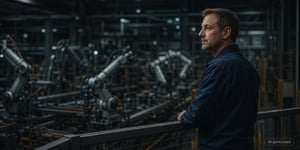
Imagine a factory with no lights on. Machines run around the clock—precise, tireless, and devoid of people. And at the same time, imagine a workshop where a carpenter is crafting a piece of furniture by hand—a piece that is sought after precisely because no machine could have made it that way.

Both images belong to the same future. While the “Dark Factory” takes automation to the extreme, craftsmanship could gain value in parallel—not despite, but because of this development.
KEY POINTS IN A NUTSHELL
|
IN A NUTSHELLThe “Dark Factory” describes fully automated, unmanned production. It is becoming increasingly realistic from a technical standpoint, and the shortage of skilled workers is accelerating its rise. At the same time, a counter-trend is conceivable: as standard work becomes a mass-produced commodity, individualized manual labor gains value—as is already the case with handmade clothing versus fast fashion, or the culinary arts versus ready-made meals. Whether craftsmanship remains a niche for the affluent or becomes a broader movement remains to be seen. Both developments could occur simultaneously. The challenge for manufacturing companies is not to choose one side, but to take both seriously. |
What is a Dark Factory?
A dark factory, also known as a lights-out factory, is a production facility that is so highly automated that it can operate without human presence. The name comes from the fact that, in such a factory, literally no lights need to be on because machines do not need light. People only intervene for maintenance, setup, and exceptional cases.
From a purely technical standpoint, this vision is no longer a distant utopia. In narrowly defined, highly standardized processes, automated production lines are already operating largely autonomously. Where workpieces, processes, and variations are clearly defined, human labor can be phased out step by step. Our article on the “Dark Factory” as a vision and path forward with the Manufacturing OS explores what a realistic path to this goal looks like, based on a unified database.
The key limitation is this: so far, processes with low variability have been the only ones to be completely devoid of human intervention. As soon as a wide range of variants, exceptions, and a touch of human intuition come into play, full automation reaches its limits. It is precisely at this boundary that the question addressed in this article arises.
Why automation is accelerating right now
The shift toward the “dark factory” is not an end in itself, but rather a response to concrete pressures. Three forces are converging to accelerate automation right now.
The shortage of skilled workers is the strongest of these forces. In many manufacturing facilities, it is becoming increasingly difficult to fill positions for assembly line and routine tasks at all. Automation is thus becoming not just a matter of efficiency, but a question of whether certain processes can continue to operate at all.
The second driver is cost pressure. International competition demands stable, predictable processes. Automated lines deliver consistent quality around the clock, without fluctuations caused by shift staffing or employee training. Our article on improving production efficiency shows how efficiency in production can be specifically enhanced.
The third driver is the maturity of the technology. Sensor technology, robotics, and data-driven control have advanced to the point where processes that still required human oversight just a few years ago can now be automated. The boundaries of what is technically possible are constantly shifting in favor of automation.
The counterargument: Is craftsmanship becoming more valuable again?
As convincing as the logic of automation may be, it may only tell half the story. There is a counterargument that is just as plausible: The more routine work is automated, the more valuable individualized manual labor could become.
The idea behind this is simple. What is available in abundance through machines loses its uniqueness. What, on the other hand, is crafted by hand, with experience and on an individual basis, gains in importance precisely because it becomes rare. Scarcity creates value. When machines take over the production of standard products, the perceived value shifts toward human craftsmanship.
This thesis does not disappear with the shortage of skilled workers; it merely shifts. The observation is that fewer and fewer people want to work on an assembly line. However, the longing for meaningful, visible work with one’s own hands does not disappear as a result. It may simply be finding a different place—away from the factory floor and toward the workshop, such as a carpenter’s shop. Our article on Industry 5.0 and the vision of human-centered production explains that this is not about humans versus machines, but rather about a human-centered perspective on technology.

What other industries are already demonstrating
The counterargument is not just wishful thinking; it follows a pattern that can already be observed in other industries. Two examples make this particularly clear.
The first is fashion. Ever since fast fashion became ubiquitous—ever since clothing became cheaply available in unlimited quantities—handcrafted clothing has once again become a status symbol. Tailoring, artisanal craftsmanship, and regional manufacturers are experiencing a renaissance, precisely because machine-made mass-produced goods are so ubiquitous. The value has shifted toward handcrafted work.
The second example is food. Ever since ready-made meals have been available on every corner, the demand for genuine culinary craftsmanship has grown. Home-cooked meals, handmade dishes, and food prepared with expertise are gaining value precisely because the opposite is so readily available. Here, too, the same principle applies: mechanical or industrial production has not displaced craftsmanship, but rather enhanced its value.
It is not certain whether this pattern can be applied one-to-one to industrial manufacturing. But it shows that, historically, the automation of routine work has not signaled the end of manual labor, but has often enhanced its value.
Skilled Labor Shortage: Both a Driver and a Potential Trigger
The skills shortage is usually cited only as an argument for automation. But it may have two sides, and the second is rarely discussed.
On the one hand, the labor shortage drives automation. When assembly line positions can no longer be filled, machines become a necessity. That’s the familiar narrative—one that our article also explores, discussing how digital worker guidance ensures quality despite the skills shortage.
On the other hand, this same shortage of skilled workers could trigger a shift—not the end of manual labor. When people avoid monotonous assembly-line work, it doesn’t mean they reject working with their hands. There is much to suggest that they are seeking a different kind of work: one that is autonomous, visible, and meaningful. The factory floor is losing its appeal, while the workshop may be gaining it.
Thus, the shortage of skilled workers becomes a dual phenomenon. It draws people away from traditional assembly-line production and drives them toward automation, while at the same time it could attract new interest in a more craft-oriented, individualized form of work. Both movements draw from the same source.
A niche for the wealthy or a broad movement?
This is where the truly open-ended question begins—one to which there is no definitive answer. Will artisanal production remain a niche for the affluent who can afford handmade furniture or custom tailoring? Or will it evolve into a broader economic movement?
The price argues in favor of the niche theory. Handcrafted items are more expensive than machine-made ones, and as long as that remains the case, handcrafted goods will tend to be premium products for affluent customers. In this scenario, Dark Factory and traditional craftsmanship coexist, but in clearly separate market segments.
History supports the “movement” theory. Craft trades have often been the answer in times of economic uncertainty, precisely because they operate independently of large supply chains. Those who master a craft are less dependent on global structures and the disruptions they entail. Whether this pattern can be applied to today’s situation—with its supply chain risks and the desire for regional value creation—is a valid question.
Both scenarios are plausible, and both could apply simultaneously in different segments. The honest answer is: We don’t know yet.
The dual perspective: automating and believing in craftsmanship
The question becomes particularly interesting when viewed from a perspective that takes both sides into account at the same time. One can work in the high-tech field of manufacturing automation, actively driving its progress forward, while at the same time being convinced that craftsmanship will not disappear as a result, but rather gain in value.
This apparent contradiction is, in reality, not one at all. Those who take automation seriously see most clearly what it can and cannot do. It excels at standardized, repetitive processes. It reaches its limits where individuality, experience, and human judgment are required. It is precisely this boundary that defines the space in which craftsmanship retains—or even regains—its value.
From this dual perspective, it is not a matter of humans versus machines, but rather a question of where humans create the greatest value. This same mindset underlies the approach of empowering— rather than replacing—production workers. Technology that relieves people of monotonous work can create space for the activities in which human skill remains irreplaceable. Automation and craftsmanship are then not adversaries, but two responses to the same development.
Dark Factory, Smart Factory, Lights-out: How These Terms Relate
Several terms related to automated manufacturing are in circulation and are often confused. A brief overview helps to properly understand the concept of the Dark Factory.
The Smart Factory describes a networked, data-driven production environment in which machines, systems, and often people work together intelligently. It is not necessarily unmanned, but above all, it is networked. The Dark Factory takes it a step further: it is the fully automated form in which human presence is not required during normal operations. The term “Lights-out Factory” means the same thing as “Dark Factory” and emphasizes the fact that no lighting is necessary.
It is important to note that the Smart Factory is the prerequisite, while the Dark Factory is the potential end goal. A facility does not become unmanned overnight; rather, it first networks its processes and data. Only on this basis can automation be taken so far that entire areas operate autonomously. The “Dark Factory” is thus less of a switch and more of a destination at the end of a long journey—and this journey leaves plenty of room for the question of what role humans will continue to play in the process.
Two visions of the future side by side
Instead of making a prediction, it’s worth comparing two visions of the future side by side and taking both seriously.
In the first scenario, the “Dark Factory” dominates. Standard production runs largely without human intervention, highly efficiently, and around the clock. People work in planning, maintenance, and handling exceptions—no longer on the assembly line. Manufacturing becomes a data-driven, automated machine in which humans manage the exceptions rather than operating the routine.
In the second scenario, a renaissance of craftsmanship is flourishing in parallel. Because the standard product is always available via machines, individually crafted items gain in value. Workshops, manufactories, and artisanal businesses are experiencing a surge in demand—not despite, but because of automation. The longing for meaningful work with one’s own hands finds its place there.
The key point is this: these two scenarios are not mutually exclusive. They can both become reality at the same time—in different segments, for different products, and for different people. The exciting question is not which scenario will prevail, but what the relationship between the two will look like. And this question is deliberately left open.
Frequently Asked Questions
What is a Dark Factory?
A dark factory, also known as a lights-out factory, is a production facility that is so highly automated that it can operate without human presence. People are only involved for maintenance, setup, and in exceptional cases. The name comes from the fact that the machines do not require any light.
Is the dark factory already a reality?
In narrowly defined, highly standardized processes, automated production lines already operate largely autonomously. However, it is primarily processes with low variability that are completely unmanned. As soon as product variety, exceptions, and a touch of human judgment are required, full automation reaches its limits.
Is automation causing the disappearance of skilled trades?
Not necessarily. There is a plausible counterargument: The more routine work is automated, the more valuable individualized craftsmanship could become. Other industries already demonstrate this pattern—for example, handmade clothing versus fast fashion, or the culinary arts versus ready-made meals.
Why might craftsmanship regain value?
Because scarcity creates value. What is available in abundance through machines becomes a mass-produced commodity. What is made by hand, with experience, and individually tailored gains significance precisely because of that. When machines take over the production of standard products, the perceived value shifts toward human craftsmanship.
What role does the shortage of skilled workers play?
The shortage of skilled workers may have two sides. It drives automation because assembly-line jobs are difficult to fill. At the same time, it could trigger a shift in manual labor—away from the assembly line and toward independent, meaningful work in the workshop.
Will skilled trades remain a niche for the affluent?
That remains to be seen. One argument in favor of it remaining a niche is the higher price of handcrafted work, which makes handcrafted goods premium products. An argument in favor of a broader movement is that, historically, skilled trades have often been the answer in uncertain times because they function independently of large supply chains.
Are “Dark Factory” and a craft renaissance mutually exclusive?
No. Both developments can take place simultaneously, in different segments and for different products. The exciting question isn’t which vision of the future will prevail, but what the relationship between automated mass production and elevated handcrafted goods will look like.