



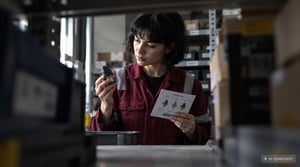
Twelve variants on one line, an inspection plan as a PDF and a seal that differs only in its Shore hardness. Final inspection says OK, the customer files a complaint. In high mix manufacturing, the most expensive defect rarely starts at the machine. It starts where the right inspection runs against the wrong variant.
Key takeaways
Quality assurance in high mix manufacturing means that every variant automatically receives its valid work steps, parameters and inspection characteristics, and that the result is bound to its serial number.
Classic inspection plans fail with high product variety because mix ups, skipped steps and outdated instructions are not reliably caught by final inspection alone.
Inspection depth should be scaled by the risk of each characteristic: safety relevant characteristics are measured and documented at 100 percent, uncritical ones are sampled.
IATF 16949 requires, among other things, a control plan (8.5.1.1), verification after every job changeover (8.5.1.3), traceability (8.5.2.1) and error proofing (10.2.4).
In many plants, product variety is normal operation. Customer specific options, country variants and small batch sizes mean that one station runs dozens of configurations within a single shift. For quality assurance this means one inspection plan per product is no longer enough, and experience stored in a few people's heads does not scale.
This guide shows where the typical gaps appear, which standards apply, how to scale inspection depth by risk and how the right inspection automatically reaches the right variant. For the basics of guiding operators through variant specific work, see our guide to worker assistance systems.
In brief
The risk sits in the changeover
When switching between configurations, a wrong part, a wrong parameter or an old instruction is easiest to miss.
Inspection depth follows risk
Not every variant needs more inspection, but every safety relevant characteristic needs a measured value with evidence.
Data instead of documents
Only when order, variant and characteristic are digitally linked does quality assurance become variant proof.
In this article
01What does quality assurance in high mix manufacturing mean?
02Why classic inspection plans fail with high product variety
03What IATF 16949, ISO 9001 and VDI/VDE 2862 require
04How to scale inspection depth by variant risk
05How the right inspection step automatically reaches the right variant
06What role operator guidance and error proofing play
07How to introduce new variants and changes without gaps
08Six steps to inspection proof high mix production
09Typical mistakes and how to assess your maturity
01 · Basics
What does quality assurance in high mix manufacturing mean?
Quality assurance in high mix manufacturing is the set of measures that ensures every product variant is built, inspected and documented with its own valid work steps, parameters and inspection characteristics. The inspection methods are the same as in classic series production. What changes is the assignment: the same station applies different specifications depending on the order.
Production is high mix when several configurations of a product run on the same line in changing sequence. This ranges from a few option packages to batch size one. For quality assurance, the number of variants matters less than how often the line switches and how similar the variants look.
How strongly product variety drives cost and complexity is well researched. A dissertation at the Chair of Product Development at the Technical University of Munich summarises studies from the automotive industry. A study on assembly planning also shows that most companies surveyed expect complexity to keep rising:
about 20 %
of process costs are caused by product variety
Stockmar 2004, cited in a dissertation at the Chair of Product Development, TU Munich
30 %
of variants are created without a specific customer requirement
Network of Automotive Excellence, cited ibid.
80 %
of respondents expect complexity in assembly planning to increase
Study on managing complexity through hybrid assembly planning
about 50 %
of the defect information companies collect remains unused (n = 100)
Empirical study, cited in a paper on defect data capture in manual assembly
The cost figures come from the automotive industry and are more than 20 years old. They are included because they show the order of magnitude. Mechanical engineering, medical technology and rail face the same questions as soon as several configurations run over one line.
02 · Failure modes
Why classic inspection plans fail with high product variety
A classic inspection plan describes what to check on a product. It assumes the product is known. That assumption breaks down in high mix manufacturing because the station first has to recognise which variant is in front of it in every cycle. Five recurring failure modes follow:
Wrong variant
A similar looking part from a neighbouring variant is installed. The inspection runs correctly, but against the wrong target values.
Skipped step
One variant needs an extra step the base variant does not have. Under cycle time pressure it gets dropped.
Wrong parameter
Torque, angle or fill quantity of the previous variant stays active because the program was not switched.
Outdated instruction
A change has been released, but the old printout is still hanging at the station.
Orphaned characteristic
A measured value is recorded but can no longer be assigned to a serial number or variant.
The obvious reaction is more final inspection. It helps only to a point. A Sandia National Laboratories study, published in the journal Human Factors in 2015, cites an industry average of about 80 percent of defective parts detected in manual visual inspection. In the study itself, 82 inspectors rejected 85 percent of the defective parts but also rejected 35 percent of the good parts. With many similar variants the odds fall further, because the inspector has to keep the target configuration in mind.
In addition, many variant defects become invisible once the part is assembled. A wrong seal or a screw tightened to the wrong torque only shows up in the field. For quality assurance in high mix manufacturing this means mix ups have to be prevented at the station where they arise.
03 · Standards
What IATF 16949, ISO 9001 and VDI/VDE 2862 require
The standards do not use the term high mix manufacturing, but their requirements hit it directly. This is most visible in IATF 16949, the automotive quality management standard that builds on ISO 9001. The overview shows which clauses become relevant during variant changeovers:
| Standard and clause | Requirement | Meaning with many variants |
|---|---|---|
| ISO 9001:2015, 8.5.1 | Production under controlled conditions, with documented information on characteristics and monitoring activities | Every variant needs its own available characteristics and inspection specifications |
| IATF 16949:2016, 8.5.1.1 | Control plan with control methods and reaction plans | Variant specific characteristics must be reflected in the control plan |
| IATF 16949:2016, 8.5.1.2 | Standardised work, operator instructions and visual standards | The instruction at the station must match the variant currently being built |
| IATF 16949:2016, 8.5.1.3 | Verification of job set ups, for example at the initial run and at material or job changes | Every variant changeover is a set up that has to be verified |
| IATF 16949:2016, 8.5.2.1 | Identification and traceability | Inspection results must be assignable to the individual serial number and variant |
| IATF 16949:2016, 10.2.4 | Error proofing | Mix ups should be prevented technically, not just detected |
| VDI/VDE 2862 Part 1 | Minimum requirements for bolted joints by category A, B and C | The category of a joint, and with it the evidence required, can change from variant to variant |
Clause 8.5.1.3 has the biggest impact. If every configuration change counts as a set up, a line with frequent variant changes has to perform this verification dozens of times per shift. On paper this is hardly feasible; digitally it becomes an automatic step at every job change.
For bolted joints, VDI/VDE 2862 applies as well. It classifies joints by criticality into categories A, B and C and derives minimum requirements for tools, monitoring and documentation.
Next step
Practical guide: 7 principles of safe operator guidance
How to systematically prevent variant mix ups, skipped steps and outdated instructions. Includes a 10 point self assessment for your line.
04 · Inspection depth
How to scale inspection depth by variant risk
More variants do not automatically mean more inspection. A useful approach scales inspection along two questions: how critical is the characteristic, and how easily can it be mixed up? A safety relevant characteristic always needs a measured value with evidence. An uncritical characteristic that does not differ between variants needs no variant specific inspection.
| Class | Typical characteristic | Inspection strategy | Evidence |
|---|---|---|---|
| 1 Safety relevant and variant dependent | Tightening torque of a category A joint, airbag or brake component | 100 percent measurement, variant confirmed by scan before the step, lock on deviation | Measured value per serial number, archived audit proof |
| 2 Function relevant and variant dependent | Seal with different hardness, connector pin assignment | 100 percent part confirmation, measurement depending on the characteristic | Confirmation with timestamp and operator ID |
| 3 Function relevant and identical across variants | Base joint that is the same in all variants | Process monitoring, statistical evaluation | Process data and indicators per period |
| 4 Uncritical | Visual characteristics without functional relevance | Sampling according to inspection plan | Sampling record |
The classification belongs in the FMEA and the control plan. That is where you define which characteristics depend on the variant and which reaction follows a deviation. Capability indices such as Cmk and Cpk are suitable for assessing individual characteristics.
Key point
Inspection depth depends on the characteristic. Inspection becomes variant dependent only where target values, parts or steps differ between configurations.
05 · Data chain
How the right inspection step automatically reaches the right variant
Every station in high mix manufacturing has to know which specifications currently apply. A continuous data chain with the serial number as its key provides that information. It has four links:
Identify
The station reads the order or serial number via scan, RFID or hand over from the MES. Without unambiguous identification there is no reliable variant assignment.
Derive
The variant follows from the order and the bill of materials. The system loads the valid work steps, parts, parameters and inspection characteristics in the released version.
Secure
Critical steps are confirmed, parts are verified by scan and tool programs switch automatically. The next step stays locked until the current one is completed correctly.
Bind
Measured values, confirmations and deviations are bound to the serial number with a timestamp and archived. The evidence becomes a by product of the work.
The core team usually knows the variants by heart in normal operation. Floaters, new colleagues and temporary staff do not know them as well, and after an engineering change even experienced operators are working from outdated knowledge. Safeguards that rely on experience therefore have gaps in exactly the shifts where staffing or the current revision changes.
06 · Operator guidance
What role operator guidance and error proofing play
At the station, the data chain needs an interface that guides people. Digital operator guidance shows only the information the current variant requires in each step and secures critical operations. This implements the error proofing that IATF 16949 requires in clause 10.2.4.
Research points the same way. A study by Pfeifroth, Dietsch and Mahlandt, published in wt Werkstattstechnik online in 2021, concludes that informational assistance systems in manual assembly have a positive effect on productivity, quality and training time. According to the literature cited there, assistance in assembly is mostly implemented through visualisation (67 percent).
Three functions are decisive for high mix lines: automatic selection of the instruction based on the order, part confirmation by scan and a direct tool connection so that programs and limits switch without manual intervention. Our guide to worker assistance systems explains how such systems are structured and how they fit into MES and ERP.
Where variants differ visually, camera based inspection directly at the step can help as well. It does not replace operator guidance, but it closes gaps for characteristics that cannot be scanned.
A station that knows in every cycle which variant it is building prevents mix ups. Final inspection finds them at best.
Key sentence
07 · Changes
How to introduce new variants and changes without gaps
Product variety is not static. New options are added, parts change, suppliers switch. Each of these changes is a risk if it does not reach the bill of materials, instruction, inspection plan and tool program at the same time. IATF 16949 therefore explicitly addresses the control of changes.
In practice, a fixed release path works best, leading every change through the same stations before it becomes effective on the line:
Record the change
Define the reason, affected variants and validity from a serial number or date.
Assess the impact
Check FMEA and control plan: does a characteristic, a class or a joint category change?
Adapt specifications
Create work steps, parts, parameters and inspection characteristics in a new version.
Release
Release by quality and production under the four eyes principle, documenting version and owners.
Activate
The new version applies at all affected stations at the same time from the defined point. Old versions can no longer be called up.
Check the first part
The first part after the change is verified and the result is bound to the serial number.
The fifth step is the hardest. As long as instructions hang printed at the station, there is no point at which the old version reliably disappears. Only a centrally maintained, digitally delivered specification makes a change effective at all stations at once.
08 · Implementation
Six steps to inspection proof high mix production
Implementation does not have to start with the whole line. A sensible approach is to start at the biggest risk and then close the data chain step by step:
Build a variant matrix
Capture all variants of the line with their differences in parts, steps and parameters. This often shows that many variants differ in only a few characteristics.
Classify characteristics
Assign every variant dependent characteristic to one of the four inspection classes and transfer the result into FMEA and control plan.
Analyse complaints
Search the defect history of recent years for variant related defects. The station with the most hits is the pilot.
Ensure identification
Make serial number or order unambiguously readable at every relevant station before setting up guidance.
Connect guidance and tools
Deliver instructions per variant digitally and assign part scans and tool programs automatically.
Track indicators
Compare variant related defects, rework and inspection effort before and after implementation.
For the last step, the rework rate works well as a leading indicator because it makes variant defects visible early.
09 · Maturity
Typical mistakes and how to assess your maturity
Common mistake
A typical mistake is to leave the variant logic in operators' heads and only digitise the documentation. A PDF on a screen is a digital copy of paper and secures nothing. As long as the station does not know which variant is being built, the risk of mix ups stays the same.
Three further mistakes are common: inspection plans are maintained per product family instead of per characteristic, tool programs are selected by hand, and defect data is collected but not analysed. The last point is well documented: according to the study of 100 companies cited above, about half of the defect information collected remains unused. The table helps you place your own status:
| Level | Characteristics | Typical risk | Next step |
|---|---|---|---|
| 1 Paper | Printed instructions and inspection plans per product family | Outdated versions at the station, no link to the serial number | Create variant matrix and characteristic classes |
| 2 Digital documents | PDF instructions on screen, variant selected by hand | Wrong variant selected, parameters not switched | Introduce identification by scan |
| 3 Guided station | Instruction loaded automatically by order, critical steps confirmed | Isolated solution without process data and archive | Connect tools, bind data to the serial number |
| 4 End to end data chain | Order, variant, measured value and evidence linked via serial number and archived | Low, focus shifts to analysis and improvement | Analyse variant defects systematically |
10 · Solution
How the Manufacturing OS by CSP secures product variety
CSP Intelligence GmbH, based in Grosskoellnbach in Lower Bavaria, has been developing software for the manufacturing industry since 1991. The Manufacturing OS by CSP is a platform that brings together all quality relevant data of a production. It consists of four modules that can be used individually or together:
| Module | Task | Contribution with many variants |
|---|---|---|
| PG | Digital operator guidance for assembly and inspection | Loads steps, parts and inspection characteristics per variant, confirms critical steps and records deviations with timestamp and operator ID |
| IPM | Real time process data management | Binds measured values and process data to the serial number as the continuous key |
| QST | Testing of tools and processes | Secures the capability of tightening tools that run different programs per variant |
| CHRONOS | Audit proof data archiving | Keeps the evidence per serial number available for audits in the long term |
On high mix lines, PG is usually at the centre. The module is controlled by work step and variant, connects tightening tools via OPC UA and switches their programs to match the variant. According to CSP, work instructions can be generated with AI support from existing Word, PowerPoint and PDF documents. For characteristics that can only be checked visually, the Vision AI module adds visual inspection directly at the station.
Stadler Rail is one example of digitally guided assembly with high documentation requirements: the company uses PG in its bogie assembly.
11 · FAQ
Frequently asked questions
What is high mix manufacturing?+
High mix manufacturing is the production of several configurations of a product on the same line in changing sequence. It ranges from a few option packages to batch size one. For quality assurance, the frequency of changeovers and the similarity of the variants are what matter.
Do I need a separate inspection plan for every variant?+
No. It is more effective to maintain an inspection plan per characteristic that defines for which variants it applies and with which target values. Only the characteristics that actually differ then need variant specific maintenance, and changes automatically apply to all affected variants.
Is a complete final inspection enough with high product variety?+
Usually not. A Sandia National Laboratories study cites an industry average of about 80 percent of defective parts detected in manual visual inspection. Many variant defects are also invisible once assembled. It is more effective to prevent mix ups technically where they arise.
What does IATF 16949 require at a variant changeover?+
IATF 16949 clause 8.5.1.3 requires verification of job set ups, for example at the initial run and at material or job changes. In high mix production every configuration change counts as such a set up. Control plan (8.5.1.1), traceability (8.5.2.1) and error proofing (10.2.4) apply as well.
How do I prevent variant mix ups in assembly?+
You prevent mix ups through unambiguous order identification at the station, instructions loaded automatically per variant, part confirmation by scan and tool programs that switch automatically. Critical steps stay locked until the previous step is completed correctly.
What data do I need for traceability with many variants?+
At minimum serial number, variant, order, parts and batches used, version of the work instruction, measured values of critical characteristics, timestamp and operator ID. The serial number serves as the continuous key that links all data.
How does inspection depth differ between critical and uncritical characteristics?+
Safety relevant, variant dependent characteristics are measured at 100 percent and documented per serial number. Function relevant characteristics are confirmed or secured through process monitoring depending on the mix up risk. Uncritical characteristics are sampled according to the inspection plan.
When does software for quality assurance in high mix manufacturing pay off?+
There is no general threshold, and no reliable industry benchmarks exist. Your own defect history is a good indicator: if complaints or rework trace back to mix ups, skipped steps or wrong parameters, digitally securing the affected stations pays off.
Next step
Check how variant proof your line is
The free practical guide covers the 7 principles of safe operator guidance, including high product variety, and contains a self assessment to rate the maturity of your stations in minutes.