
In 2030, someone asks about 2008. How long will it take to get an answer?
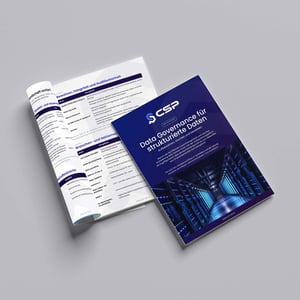
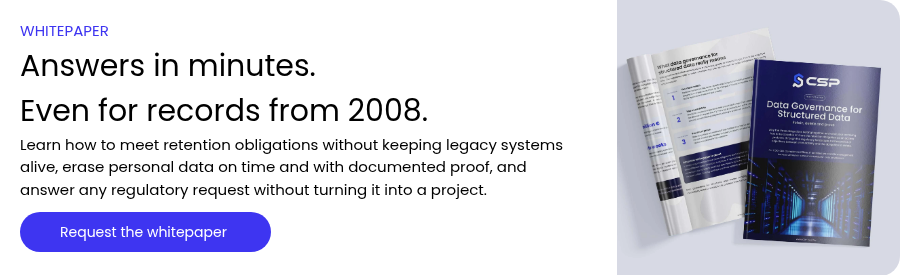
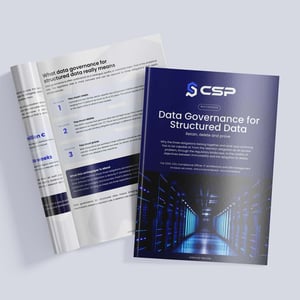
Retention requirements aren’t a storage problem. They’re an access problem with a burden of proof. This white paper shows how retention, deletion, and proof converge in a single dataset and what your archiving solution needs to be able to do to handle it.
✓ Three obligations: retain, delete, prove
✓ Standards landscape sorted: AO, HGB, GoBD, GDPR, ISO 27001
✓ Eight requirements as an evaluation framework for every archiving tool
For CDOs, CIOs, compliance officers, IT architecture, and quality management leadership
Database Archiving · Application Retirement · Data Governance
The exam isn't the time to start writing about the topic.
An application has technically reached the end of its lifecycle but cannot be shut down because its data is subject to a retention requirement. It continues to run, serving solely as a data repository, and ties up resources such as licenses, maintenance, operations, hardware, and specialized expertise—all of which are becoming increasingly scarce within the organization.
The second cost factor is invisible and relates to compliance: When a regulatory inquiry is received, the search begins in legacy systems, exported data, and spreadsheets. What on paper was a retention requirement turns out, in practice, to be a research task that takes anywhere from days to weeks.
“Anyone who has the data but cannot make it retrievable, readable, and verifiable within a reasonable amount of time has failed to fulfill their obligation.”

What's in the white paper
From the three regulatory obligations, through the complex landscape of standards and the conflict of objectives between immutability and the obligation to delete data, to the calculated business case. Including the sections where we explain what our own tool cannot do.
Request the full white paperThe Three Obligations
Retention, deletion, and proof apply simultaneously and relate to the same dataset.
The Standards Landscape at a Glance
Four clusters ranging from AO and HGB to GoBD and GDPR, through ISO 27001, DORA, MDR, and industry-specific regulations.
Why the Standard Answers Aren't Enough
Backup, keep the legacy system running, DMS, or a custom solution. Four answers that don’t solve the problem.
Eight Requirements as a Checklist
Specific evaluation questions for each archiving tool, ranging from retention policies to procedural documentation.
The Conflict of Objectives
Immutability versus the obligation to delete data on the same storage medium, and the only reasonable responses to this conflict.
The Business Case
Where the ROI comes from, with a sample calculation over five years and three real-world case studies.

Get the whitepaper
Three Responsibilities, One Mechanism.
In many organizations, three different departments handle these responsibilities using three different tools. As long as these are separate processes, each audit is a project. Data governance for structured data brings them together around a single dataset.
Retention periods ranging from 6 to 50 years
Commercial law, tax law, industry-specific laws, and product liability laws prescribe retention periods. The retention period applies to the content itself, not to the application in which it was created.
TYPICAL SCOPE OF RESPONSIBILITY
To date: IT via backup and storage
GDPR Art. 5 and Art. 17
Personal data may not be retained longer than necessary and must be deleted upon request. This does not contradict the requirement to retain data, but rather represents an equally important obligation with a different focus.
TYPICAL RESPONSIBILITIES
Previously: Data protection through policies and lists
When, by whom, and on what basis
Both obligations are meaningless if their fulfillment cannot be verified. An auditor does not ask whether you deleted the data, but rather when, by whom, and whether the data record has been modified in the meantime.
TYPICAL RESPONSIBILITIES
Previously: Audit based on retrospective reconstruction
Three projects, three proven results.
Application Retirement and Database Archiving with CHRONOS. The complete case studies are available in the white paper.
Growing production databases drove up licensing, storage, and operating costs, while traceability requirements prevented the system from being shut down.
Insolvency proceedings with continuous access for courts, government agencies, and social security providers. Other providers considered the project unfeasible.
IT realignment following a merger: multiple legacy ERP systems consolidated centrally; compliance requirements automatically met.
“If, in 2030, someone asks about a process from 2008: will a clerk simply click on a PDF, or will a legacy system have to be booted up again?”
Get the white paper, and then sign up for your live demo.
In 30 minutes, we’ll use your own data to show you how retention, deletion, and proof-of-compliance all come together in a single dataset. Specifically, using your data.