




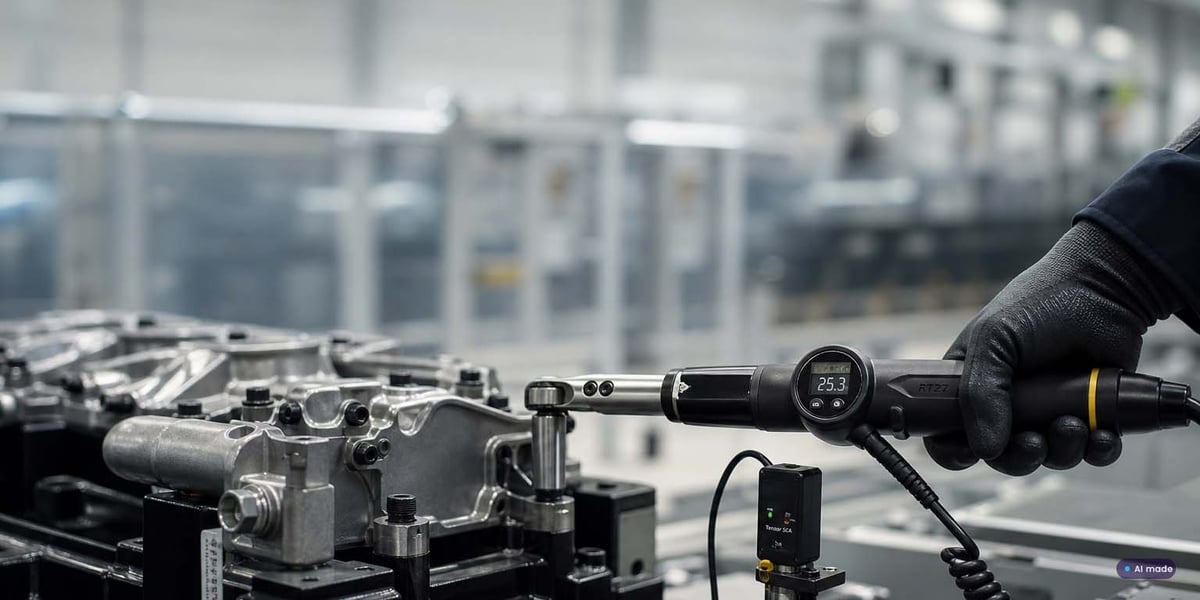
In high-variety series production, quality is not determined during final inspection, but at every single station. When different models are being produced on an assembly line, the most costly errors occur when one variant is confused with another, a step is skipped, or a safety-critical screw connection is assessed based on feel rather than a calibration curve.
Many companies address this with separate systems: an operator guidance system here, an inspection data collection system there, a QM system for documentation, and the MES somewhere in between. Every interface between these systems is a point where traceability breaks down and where, in the event of a complaint, data must be manually pieced together.
This article explains what quality management software for serial production must actually deliver, why the integration of operator guidance, traceability, and QM in the CSP Manufacturing OS makes the decisive difference, and how to recognize a viable solution. The tone is that of an engineer, not that of a brochure: with numbers, references to standards, and the limitations where something doesn’t work.
THE MOST IMPORTANT POINTS AT A GLANCE
|

IN SHORT
|
What Quality Management Software Must Deliver for Manufacturing
Quality management software for manufacturing is more than just a digital inspection report. It captures quality-related data during the ongoing process and intervenes in it. The difference from pure document management is fundamental: document management handles quality retrospectively, while manufacturing QM software prevents errors in real time.
Various types of data are generated on the production line and must be consolidated: inspection results (pass/fail, measured values), process parameters (such as torque and angle of a screw connection), defect and rework data, as well as the associated identification data consisting of operator ID, batch number, and serial number. Only by linking these data types to a serial number can reliable proof of quality be established.
|
IATF 16949 Section 8.5.2 requires traceability throughout the entire process chain IATF 16949:2016 |
VDI/VDE 2862 specifies the screw connections that must be documented VDI/VDE 2862 Part 1 |
2026 Stricter EU Product Liability Directive shifts the burden of proof to the manufacturer EU Directive 2024/2853 |
OPC UA / REST Established standards for machine and system integration CSP Project Practice 2024/25 |
Why Separate Systems Reach Their Limits in Mass Production
Separate systems are rarely the result of a deliberate decision. They develop historically: First came the ERP system, then a test equipment management system, later an operator guidance system for critical production lines, and finally a quality management system for audits. Each makes sense on its own. Taken together, however, they form a patchwork quilt with data gaps at every seam.
The following three data gaps appear in nearly every organically grown system landscape. They are ranked according to the severity of their impact on traceability, from those with immediate effects to those with structural implications.
| Data Discontinuity | What’s the Problem? | Impact on quality | Core Problem |
|---|---|---|---|
| 1 · Operator guidance ↔ Test data capture | Inspection results are assigned retroactively; time lag between execution and evaluation; assignment errors when switching between variants | Sequence and mix-up errors go undetected; no block on further processing for non-conforming parts | The error is detected rather than prevented |
| 2 · Test Data ↔ QM Documentation | Aggregated rather than individual records; aggregation obscures the serial number link; manual exports and versioned Excel files | End-to-end traceability only possible with significant reconstruction effort; audit gaps between data entry and archiving | The traceability is reconstructed, not complete |
| 3 · QM ↔ MES/ERP | Defect costs cannot be assigned to specific orders; no traceability from complaints to production lots; duplicate master data maintenance | Root cause analysis stops at the system boundary; key metrics drift between systems | The system boundary is also the boundary of the root cause analysis |
The common pattern: At every interface, the serial number must be reconciled between two systems. As long as this reconciliation is performed manually, with a time lag, or in an aggregated manner, the end-to-end traceability is not complete but reconstructed. Reconstructed traceability rarely holds up in an audit and never in a liability case.
What distinguishes the CSP Manufacturing OS from a standalone QM solution
The CSP Manufacturing OS is not a collection of retroactively integrated modules, but rather a shared database in which shop floor management, inspection data collection, QM workflows, and MES functions work together from the very beginning. The difference from a standalone QM solution is not a functional one, but an architectural one: There is no interface between the modules because there are no separate data sets.
The linchpin is the primary key. In the CSP Manufacturing OS, the serial number serves as the continuous key from the raw material batch to the final product. Each station records its quality data against this serial number without the need for synchronization between modules.
| Station | Recorded Quality Data | Linked to | Readiness for Verification |
|---|---|---|---|
| Goods Receipt | Batch number, material certificate, lock status | Serial number | Complete |
| Assembly station | Variant check, sequence confirmation, operator ID | Serial number | Complete |
| Screw connection | Torque, angle, tightening curve, tolerance assessment | Serial number | Complete |
| In-line inspection | Measured values, image and sensor data, Pass/Fail | Serial number | Complete |
| Final inspection / Shipping | Release status, test report, packaging data | Serial number | Complete |
The practical benefit becomes apparent in the event of a complaint. If a part with a specific serial number is returned, the CSP Manufacturing OS provides the complete history with a single query: which variant, which operator, which screwdriving profile, and which inspection result at each station. In a siloed system environment, this is where a data search across multiple systems begins—and, if you’re lucky, the results will be complete.
| Feature | Separate Individual Systems | CSP Manufacturing OS |
|---|---|---|
| Primary Key | Each system has its own ID; synchronization required | Consistent serial number |
| Traceability | Reconstructed from multiple sources | Byproduct of operations |
| Worker guidance | Separate from inspection data | Based on the same data |
| Allocation of defect costs | Not order-specific | By order and serial number |
| Master data maintenance | Multiple times, per system | Once, centrally |
| Audit effort | Data search across systems | One access per serial number |
Why Architecture Is More Important Than Feature Set
Two systems may have the same feature set listed on their spec sheets but differ fundamentally in practice. What matters is not whether a function is available, but whether its data is seamlessly linked to the serial number. A work instruction system whose confirmations are not linked to serial numbers and stored in the same database as the inspection data does not produce a consistent audit trail, no matter how good its individual components may be.
How operator guidance prevents assembly errors at the point of origin
Step- and variant-driven operator guidance is the most effective single measure against assembly errors in high-variety series production. Its principle is simple: The next step is not released until the current one has been correctly performed and confirmed. The error is prevented at the point of origin, not detected at the end of the line.
The three most common types of errors at a mixing station where different models are produced, and how integrated operator guidance catches each one:
| Defect Type | Without operator guidance | With CSP Manufacturing OS | Impact |
|---|---|---|---|
| Variant Mix-Up | The operator selects the standard variant even though a special type is being produced. The paper work order shows only the standard case. | The system displays the correct component specific to the variant and blocks any deviating selections. | Variant mix-up errors are prevented at the workstation, rather than being detected during final inspection |
| Sequence error | A test step is skipped due to production pressure and is not noticed until the product reaches the customer. | The next step is not released until the previous one has been confirmed as completed. | Omitted steps are no longer technically possible; every step is accounted for |
| Screw connection outside tolerance | A screw connection is classified as OK even though the angle deviates. Assessment is based on feel rather than a calibration curve. | Tightening is not acknowledged until the torque and angle are within the tolerance band. | Safety-critical bolted joints are documented in accordance with standards; non-conforming (NIO) cases are blocked |
The common denominator of the three cases: The source of the error is not the operator, but the lack of guidance during the production cycle. A step-by-step warning system that detects deviations and documents them with a timestamp and operator ID transforms a post-hoc inspection into proactive prevention.
The most expensive inspection is the one that finds an error that could have been prevented at the workstation. Operator guidance shifts quality focus from inspection to production.
— Amadeus Lederle, Chief Technology Executive, CSP Intelligence GmbH
| Implementation Mistakes | Why it’s harmful | Practical Tip |
|---|---|---|
| Too Many Prompts | If every trivial step must be acknowledged, the operator will keep clicking out of habit. The guidance loses its effectiveness exactly where it matters most. | Provide guidance only at critical steps; keep the rest visible but without mandatory confirmation. |
| Too few mandatory confirmations | Steps critical to safety and process variants remain unchecked, even though this is precisely where the most costly errors occur. | Apply mandatory acknowledgments specifically to safety-critical and variant-critical steps. |
| Rigid guidance without variant logic | Every type change causes friction because the guidance system is unaware of the current order. | Link the guidance system to the order so that it automatically adjusts to the correct variant. |
How traceability is achieved in mass production without additional effort
Many view traceability in mass production as a documentation burden. In CSP Manufacturing OS, it’s the opposite: a byproduct of ongoing operations. Because every station records the serial number anyway, a complete history is created without anyone having to generate it separately.
The normative basis is clearly defined. IATF 16949 Section 8.5.2 requires traceability throughout the entire process chain. VDI/VDE 2862 specifies this requirement for safety-critical screw connections and defines which screw connections must be documented. VDI/VDE 2645 governs the associated calibration of fastening tools. Three entities, two clear relationships: The IATF sets the framework, and the VDI/VDE guidelines specify it for fastening applications.
Since 2026, the new EU Product Liability Directive has further tightened the situation because it shifts the burden of proof in the event of damage to the manufacturer. Anyone who cannot prove, down to the serial number, that a part was manufactured in compliance with standards bears the risk in the event of a dispute. Seamless traceability has thus gone from being a nice-to-have to a prerequisite for delivery capability.
What “end-to-end” actually means
“End-to-end” means that there is a closed chain for every serial number—from the raw material batch at goods receipt all the way to the delivered end product. The batch documentation from goods receipt is linked to the assembly and inspection data from each station, which in turn is linked to the shipment’s release status. If the chain is broken at any point, the documentation for that part is worthless, regardless of how completely the remaining stations are documented. This is precisely why continuous serial number tracking is not a convenience feature, but a core requirement.
How the Integration of MES and Quality Management Closes the Data Gap
The integration of MES and quality management is the point at which many digitalization projects in manufacturing either succeed or fail. An MES controls the process, while QM ensures quality. As long as the two remain separate, error costs cannot be assigned to specific orders, and complaints cannot be traced back to the production lot.
The technical path to integration lies in open interfaces, not in replacing all systems. OPC UA has established itself as the standard for machine and equipment connectivity, while REST is the standard for system integration with ERP and higher-level platforms. A viable solution integrates existing systems: order data comes from the ERP, machine statuses are transmitted via OPC UA, and quality data is fed back linked to serial numbers.
It is important to honestly assess where integration has its limits. A connection is only as good as the data quality of the connected systems. If work plans in the ERP are not properly maintained or variants are not clearly mapped there, no integration can bridge this gap. The preparatory work on master data determines the success of the integration more than the interface technology itself.
Selection Criteria: How to Identify a Viable Solution
Not every solution that calls itself quality management software for manufacturing is suitable for high-variety series production. The following criteria distinguish viable solutions from digital inspection reports. They are listed in order of their importance for traceability.
| Criterion | What to Look For | Why it matters |
|---|---|---|
| Consistent primary key | Serial number links all data across all stations | Without it, end-to-end traceability is impossible |
| Variant-Controlled Worker Guidance | Supervision knows the current order and only authorizes the appropriate variant | Mix-up errors are the most costly type of error at mixing stations |
| Process data linkage | Screwing curves and measured values are linked to serial numbers rather than aggregated | VDI/VDE 2862 requires individual verification, not aggregate values |
| Open interfaces | OPC UA for machines, REST for systems | Integration, not replacement, protects existing investments |
| Audit-proof archiving | Immutable, time-stamped documentation | GoBD and IATF compliance, audit-ready |
| Gradual implementation | Phase by phase instead of a “big bang” | Reduces project risk and ensures early benefits |
One criterion is deliberately omitted from this list because it is overrated: the sheer scope of functionality. Two systems with identical feature lists can differ fundamentally in practice, depending on whether their data is seamlessly linked to the serial number. Examine the architecture, not the feature table.
The CSP Manufacturing OS: Quality Management Software as an Integrated Platform
The CSP Manufacturing OS is precisely the integrated platform described in this article as a requirement: a shared database instead of separate siloed solutions. Four modules cover the key aspects of industrial quality assurance and share the same data set.
| Component | Function | Covers |
|---|---|---|
| IPM | Process Data Management: Collects and monitors quality-relevant process data in real time, triggers alerts in case of deviations | Process data, early warning |
| QST | Quality Assurance & Tool Inspection: inspects and documents joining processes such as screwing, riveting, and crimping, regardless of the manufacturer | Inspection, Process Data Integration |
| PGX | Operator Guidance: Provides visual, variant-driven guidance through assembly, inspection, rework, and revision | Operator Guidance, Error Prevention |
| CHRONOS | Database Archiving: Archives quality-relevant and system-critical data in compliance with GoBD and OAIS standards, in an audit-proof manner | Traceability, audit trail |
Frequently Asked Questions
What is quality management software for manufacturing?
Quality management software for manufacturing is a system that captures, evaluates, and documents quality-related data directly within the production process. This includes inspection results, process parameters such as tightening curves, defect and rework data, as well as the associated operator, batch, and serial numbers. Unlike a pure document management system, which manages quality retrospectively, manufacturing QM software intervenes in the ongoing process: It guides the operator, approves or blocks inspection steps, and prevents defective parts from being passed on to the next station.
What is the difference between MES and quality management software?
An MES (Manufacturing Execution System) controls and monitors the production process: orders, capacities, machine statuses, and feedback. Quality management software focuses on inspection, defect management, traceability, and compliance with standards. In separate systems, data gaps arise at the interface. In CSP Manufacturing OS, both functional areas are unified in a single database via the modules, so that an inspection result is immediately linked to the corresponding production order and serial number without the need to synchronize data between systems.
How does operator guidance reduce assembly errors in mass production?
Digital operator guidance shows the operator the correct next step for the specific variant and does not release the following work step until the current one has been correctly confirmed or measured. For safety-critical screw connections, for example, tightening is not acknowledged until the torque and angle are within the tolerance range. This prevents errors from occurring at the point of origin, rather than being discovered at the end of the line. In high-variety production, where different models are processed at a single station, this is the most effective single measure, as this is where most mix-ups and sequencing errors occur.
Which standards require traceability in the automotive supply industry?
The key requirement is set forth in IATF 16949, Section 8.5.2, which mandates traceability throughout the entire process chain. For safety-critical bolted joints, VDI/VDE 2862 specifies the bolted joint configurations that must be documented, while VDI/VDE 2645 governs the associated calibration. In addition, the stricter EU Product Liability Directive, which took effect in 2026, shifts the burden of proof to the manufacturer in the event of damage. All in all, seamless traceability down to the serial number level is no longer a nice-to-have but a prerequisite for supplying OEMs.
Is an integrated solution more worthwhile than multiple standalone systems?
For companies with a small number of variants and few workstations, standalone systems may suffice. As soon as the number of variants increases and traceability must be down to the serial number, the math changes: Every interface between operator guidance, test data collection, and quality management is a point where data must be reconciled, maintained, and—in the event of an error—manually pieced together. In high-variety series production, the effort required to integrate multiple siloed solutions regularly exceeds the effort required for a unified platform—and traceability remains incomplete nonetheless.
How can an existing MES or ERP landscape be integrated?
Through open interfaces. OPC UA has established itself as the standard for machine and equipment connectivity, while REST interfaces are used for system integration with ERP and higher-level platforms. A robust quality management software solution integrates existing systems rather than replacing them: order data comes from the ERP, machine statuses via OPC UA, and quality data flows back linked to serial numbers. It is crucial that the serial number remains the same primary key across all connected systems.
How quickly can such a solution be deployed on a production line?
That depends on the number of stations, the complexity of the variants, and the available data. A single assembly line with defined work plans and connected screwdriving tools can be brought online in just a few weeks. The time-critical part is rarely the software itself, but rather the accurate modeling of work plans and inspection characteristics for each variant. Companies that structure this modeling in advance significantly shorten the implementation time. A phased rollout, station by station, is the norm and reduces risk compared to a “big bang” transition.
For what size of company is integrated QM software suitable?
The benefits scale with the number of variants and traceability requirements, not primarily with the number of employees. A small supplier with safety-critical bolted joints and a high variety of variants often benefits more than a large company with simple, stable processes. The common assumption that integrated manufacturing software is only worthwhile above a certain size is misleading: the decisive factor is the complexity of the traceability and operator guidance requirements, not revenue.